how to demo that bathroom you're about to DIY

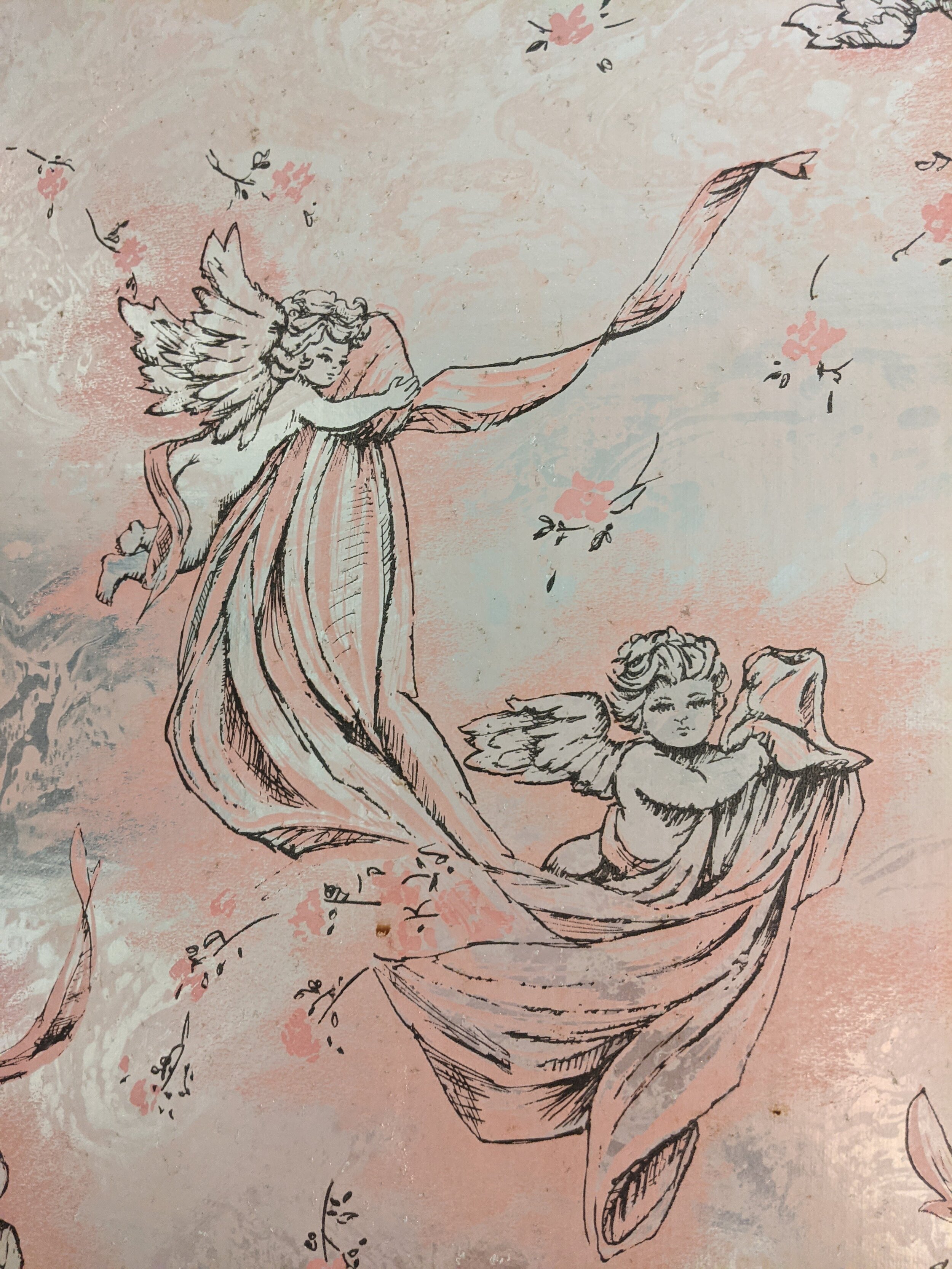
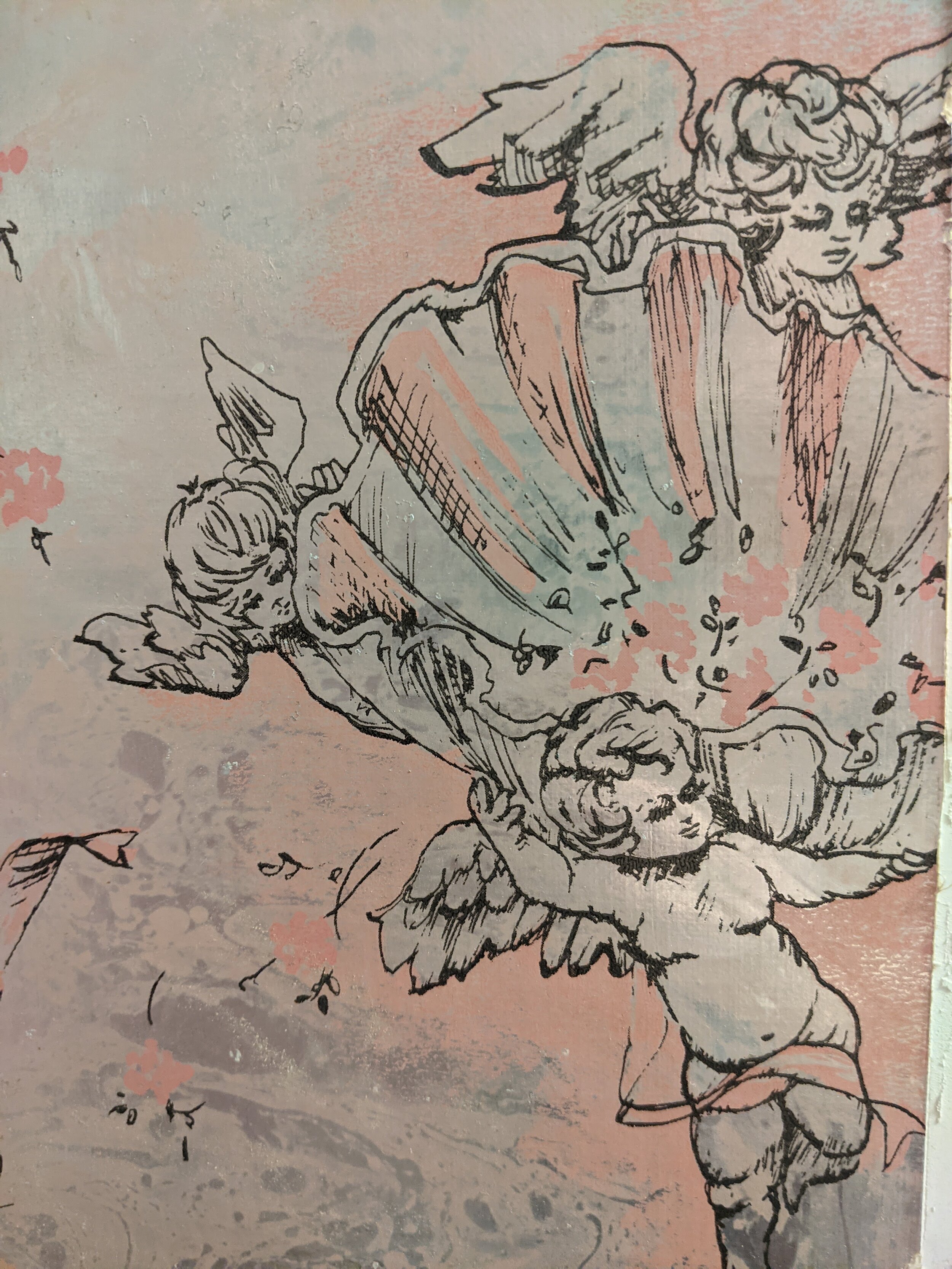
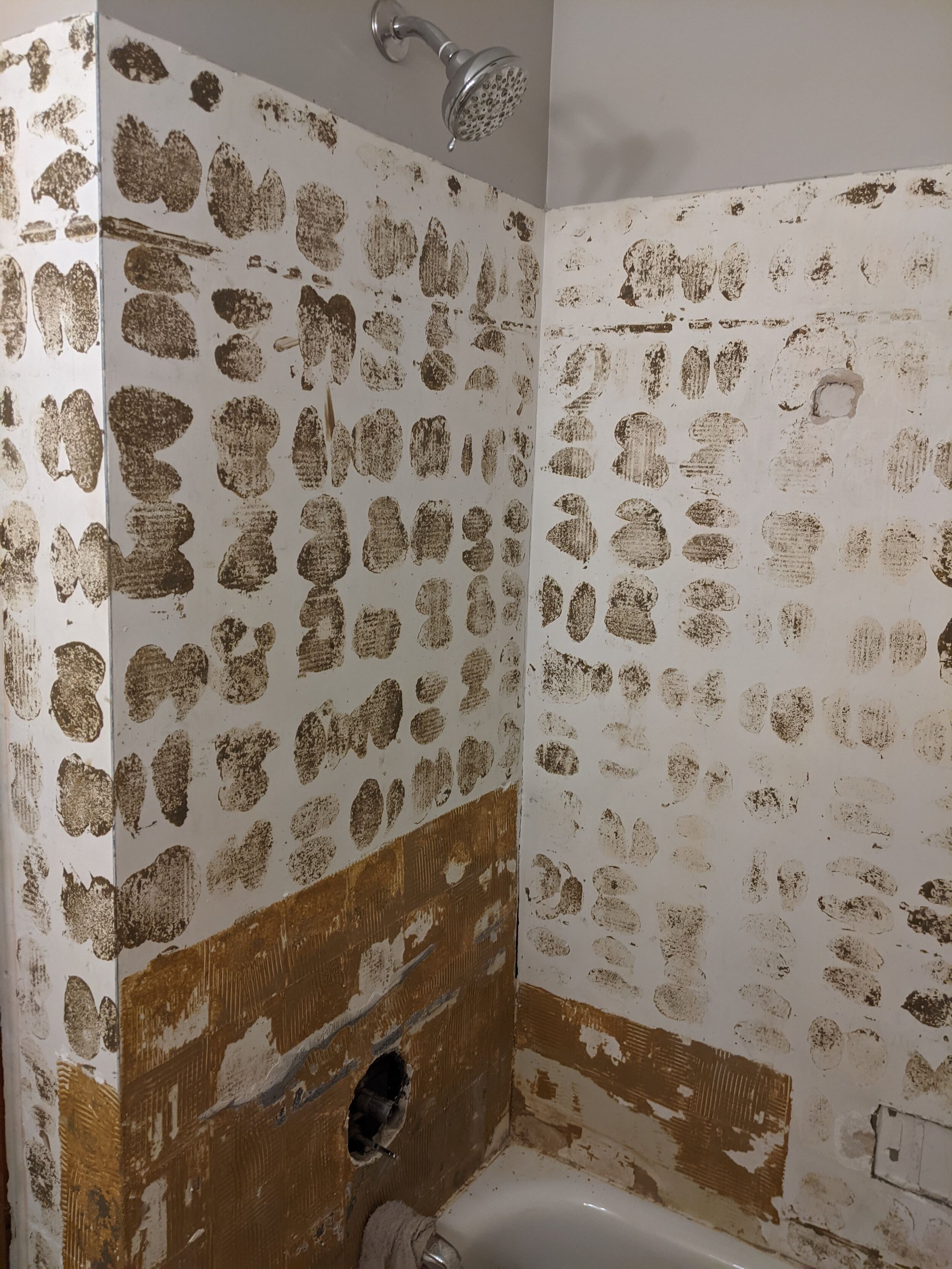
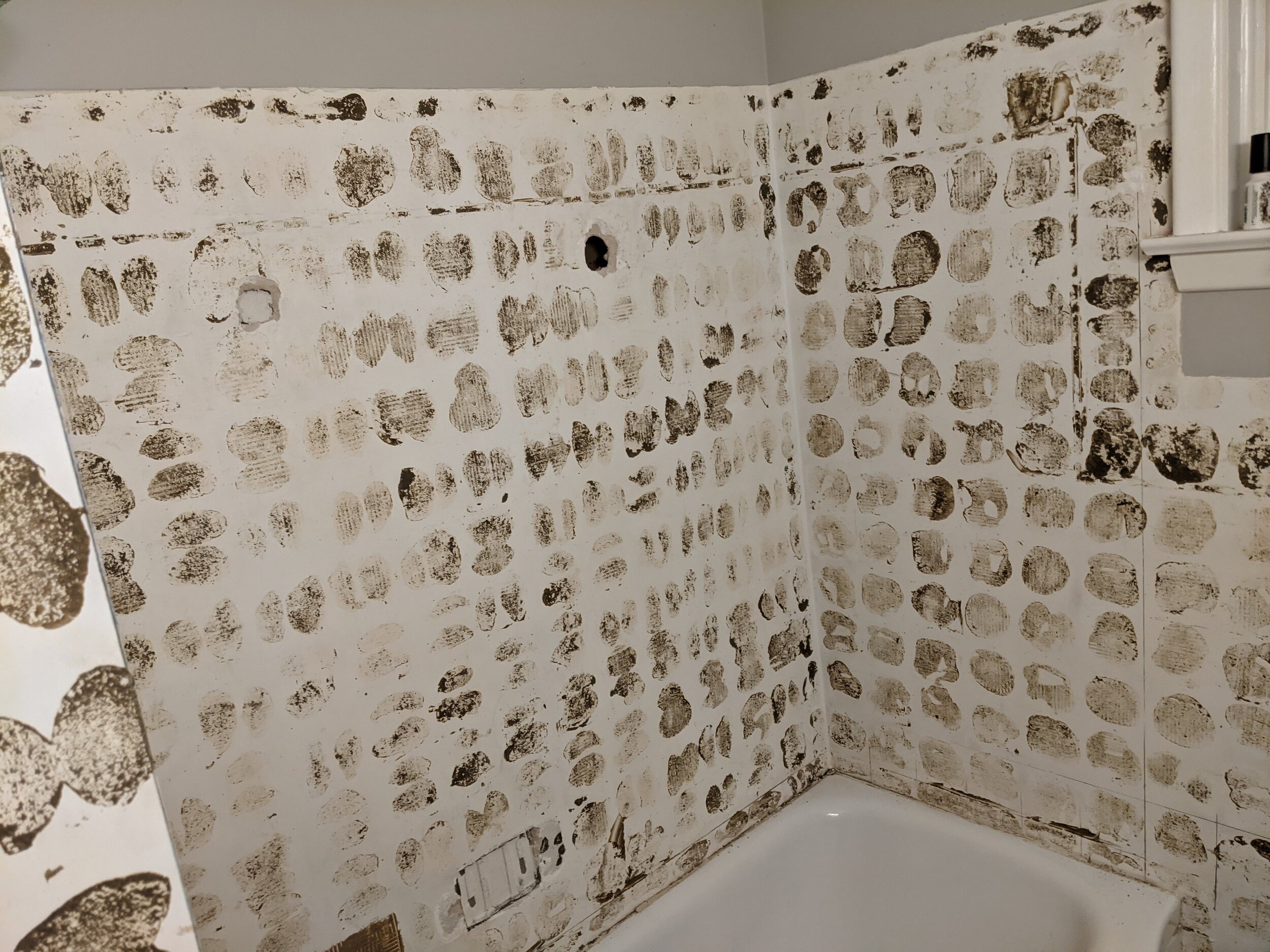
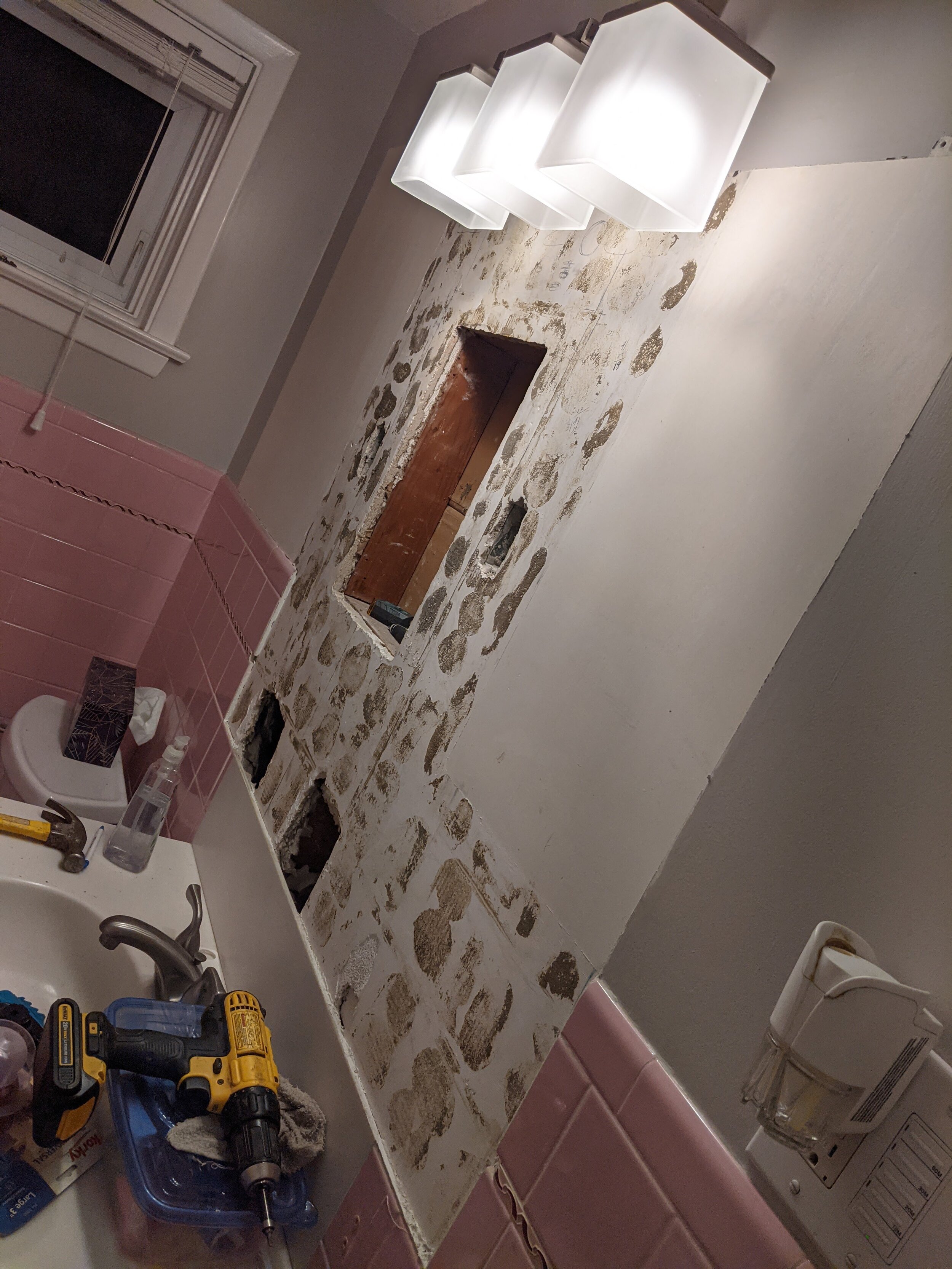
Metallic. Naked. Baby Angels. Oh my goodness. You never know what you are going to discover with home demolition — we’re found mouse graveyards galore — but this wallpaper takes the cake. The funniest part is how this is ALMOST so hideous that it’s really cute again. In fact, I posted it on my personal FB wall and a bunch of friends said they loved it.

We did a quick mini-reno of this bathroom when we bought the house and took down metallic flowered wallpaper from the exposed walls, but behind the mirror was this glorious previous iteration:
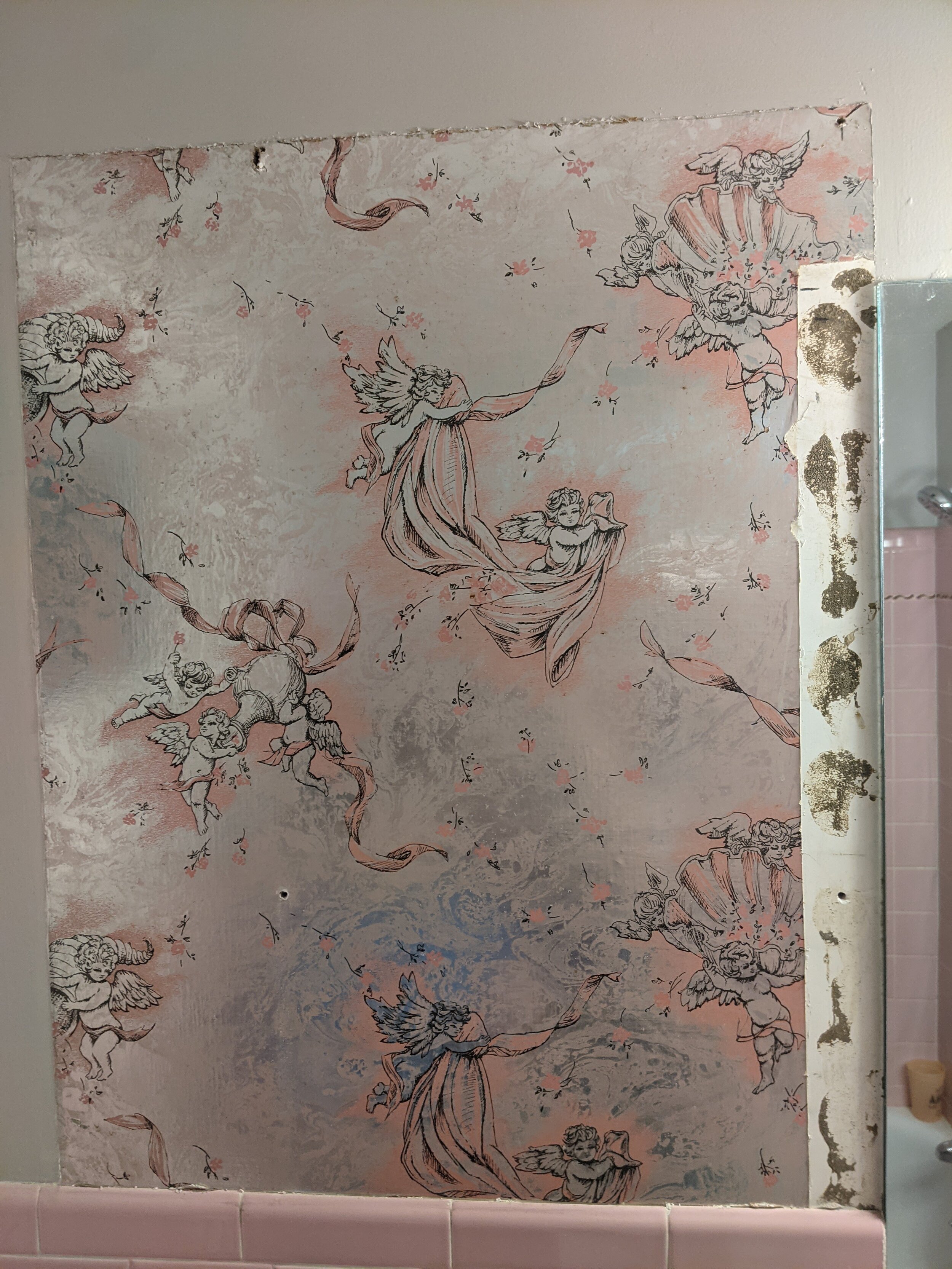
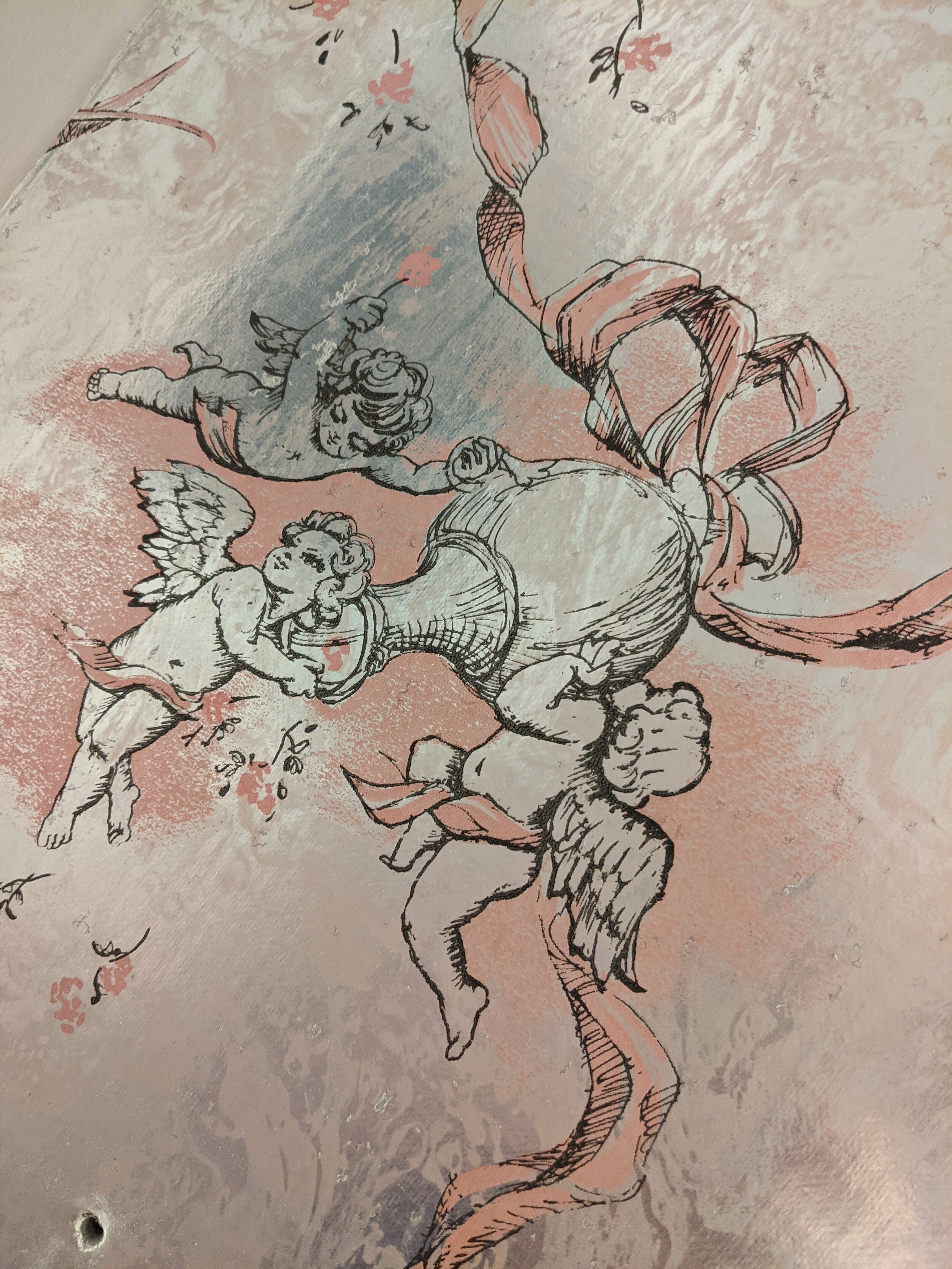
I asked my husband (at the end of the project) if the previous homeowner was as excited about her angel butts as I am about my trendy blues and whites, ad he said yes. So future generations can think I have hilarious taste, congrats. You’ll probably knock down my blue and white subway tiles to hang up olive green hyena footprints or something.

Whatever. I hope you love it, future homeowner.

Our process was:

  • Rent a dumpster

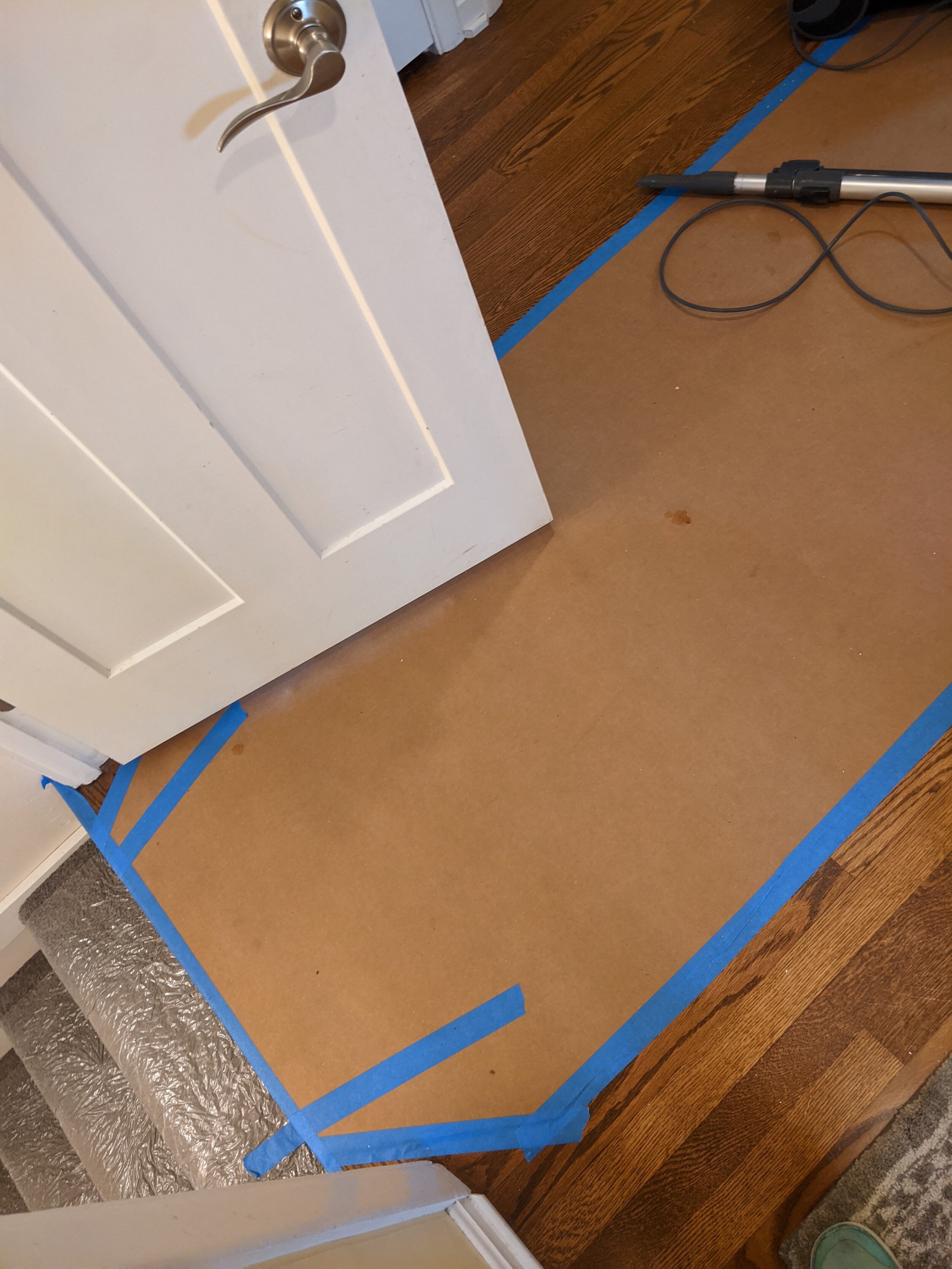
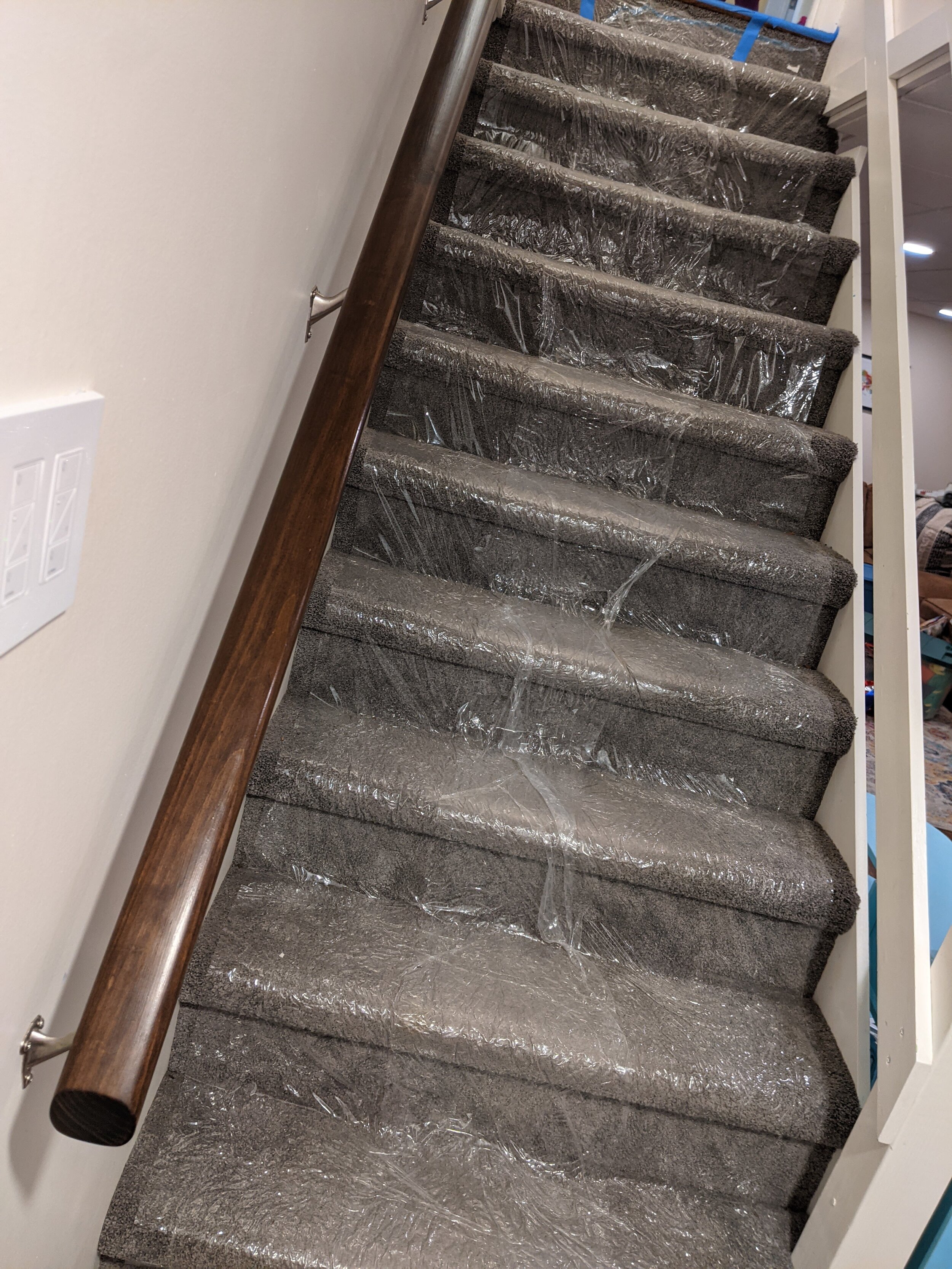
  • Put down floor protection (really cannot emphasize how critical this is — tiles get stuck into your shoes and will DESTROY your flooring)

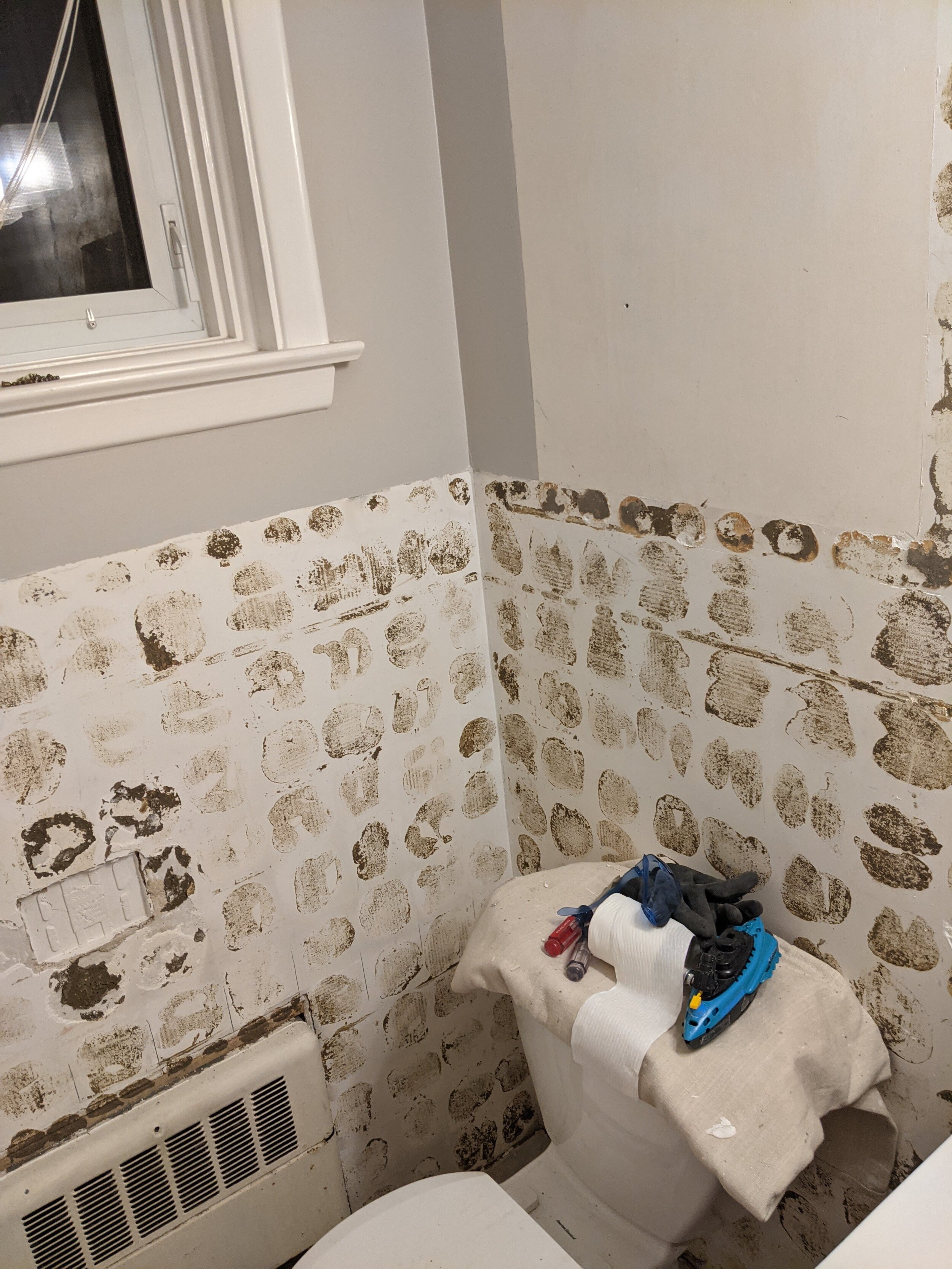
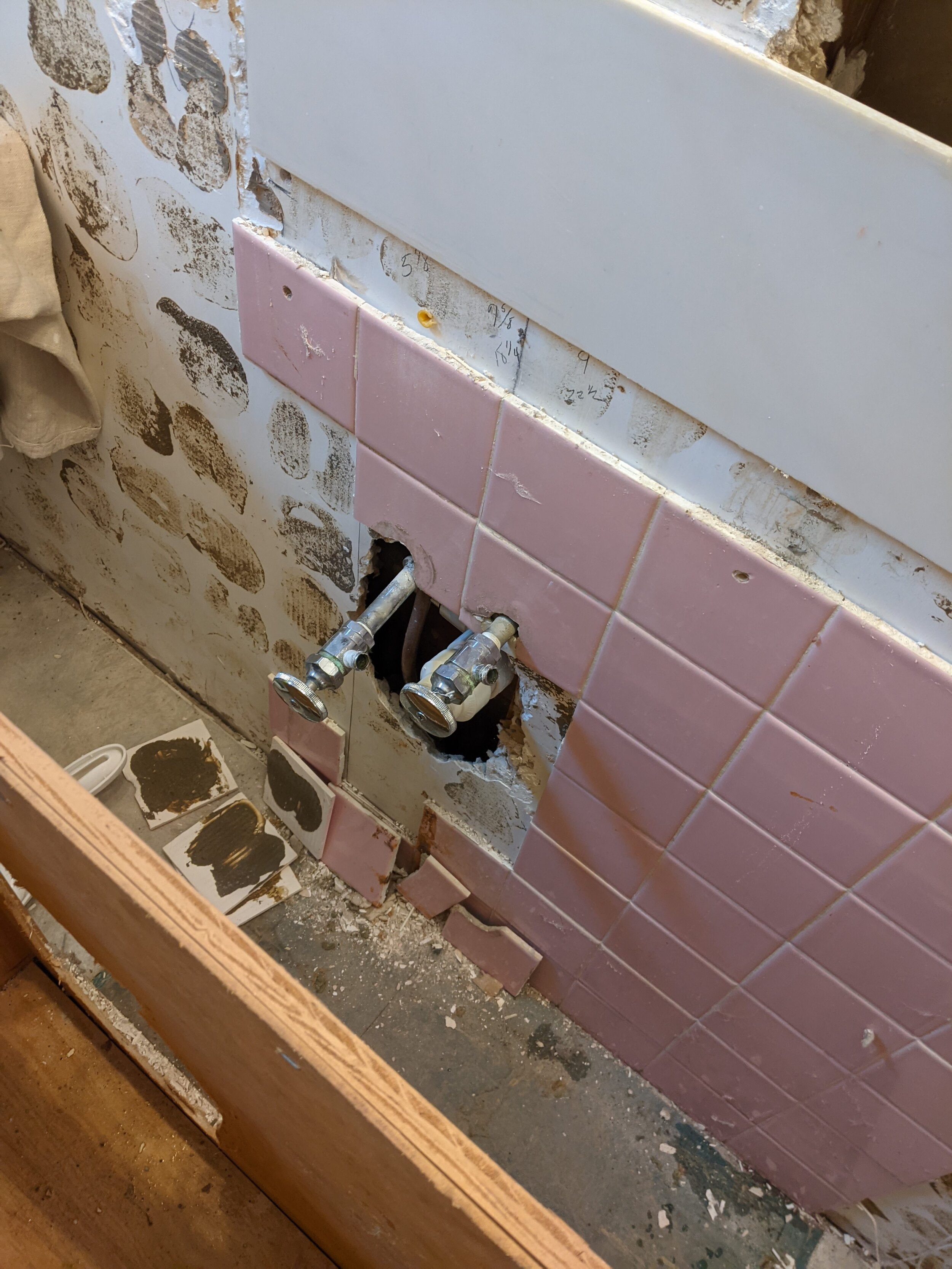
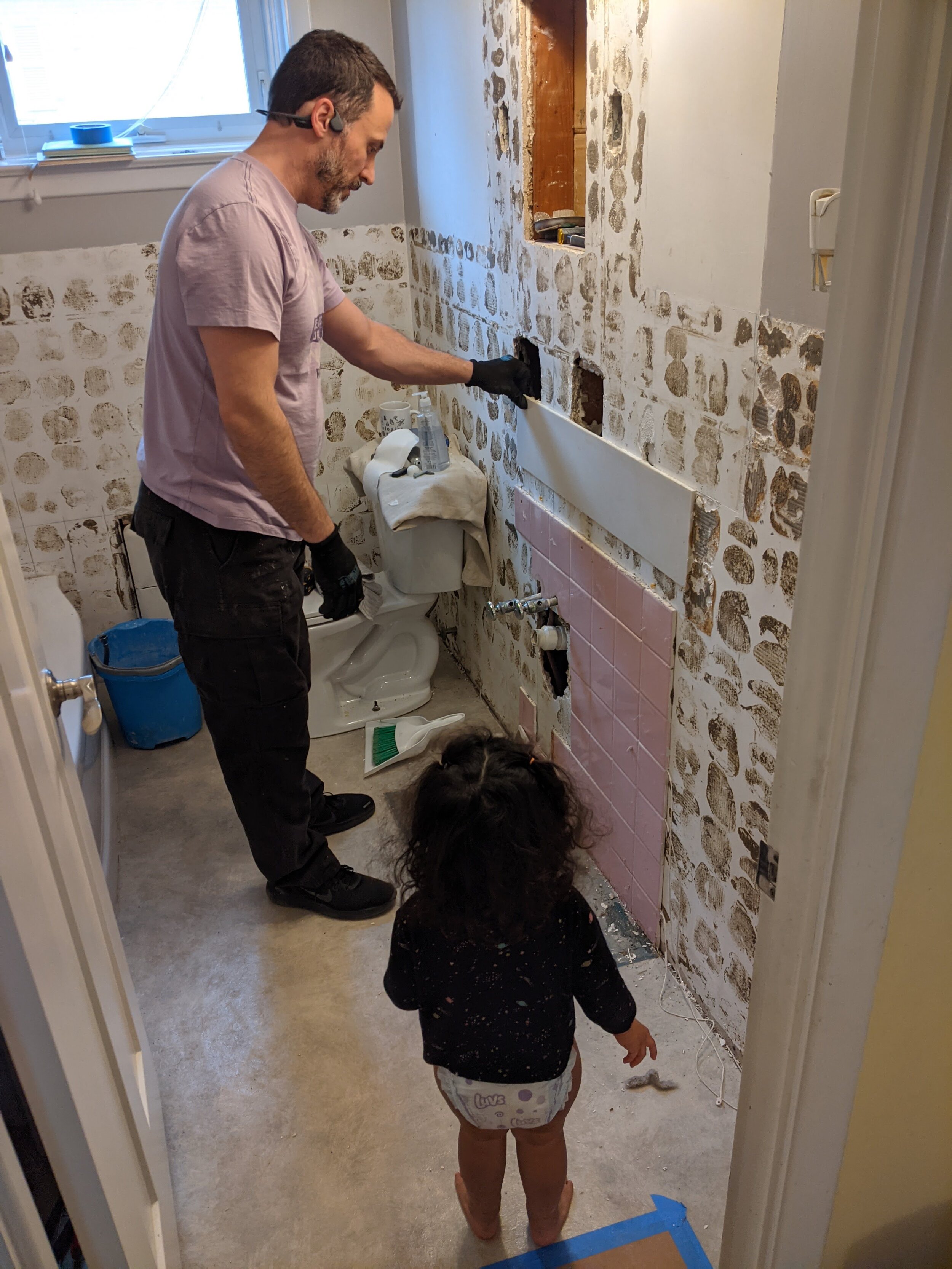
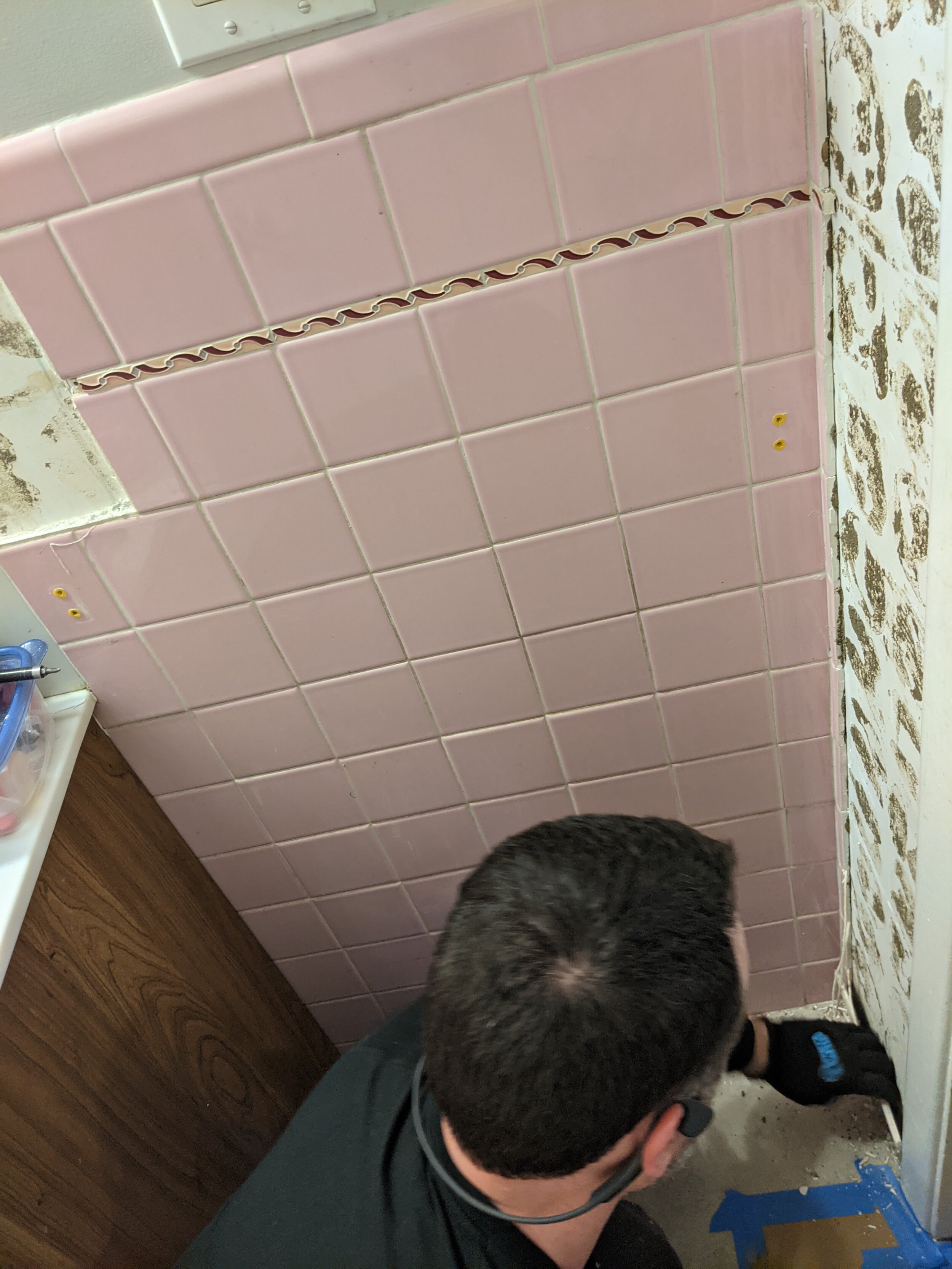
  • Knock off the tiles and carry them to the dumpster

  • Still knocking off tiles

  • Still carrying more tiles

  • How are we not done yet?

  • Why are there so many tiles?

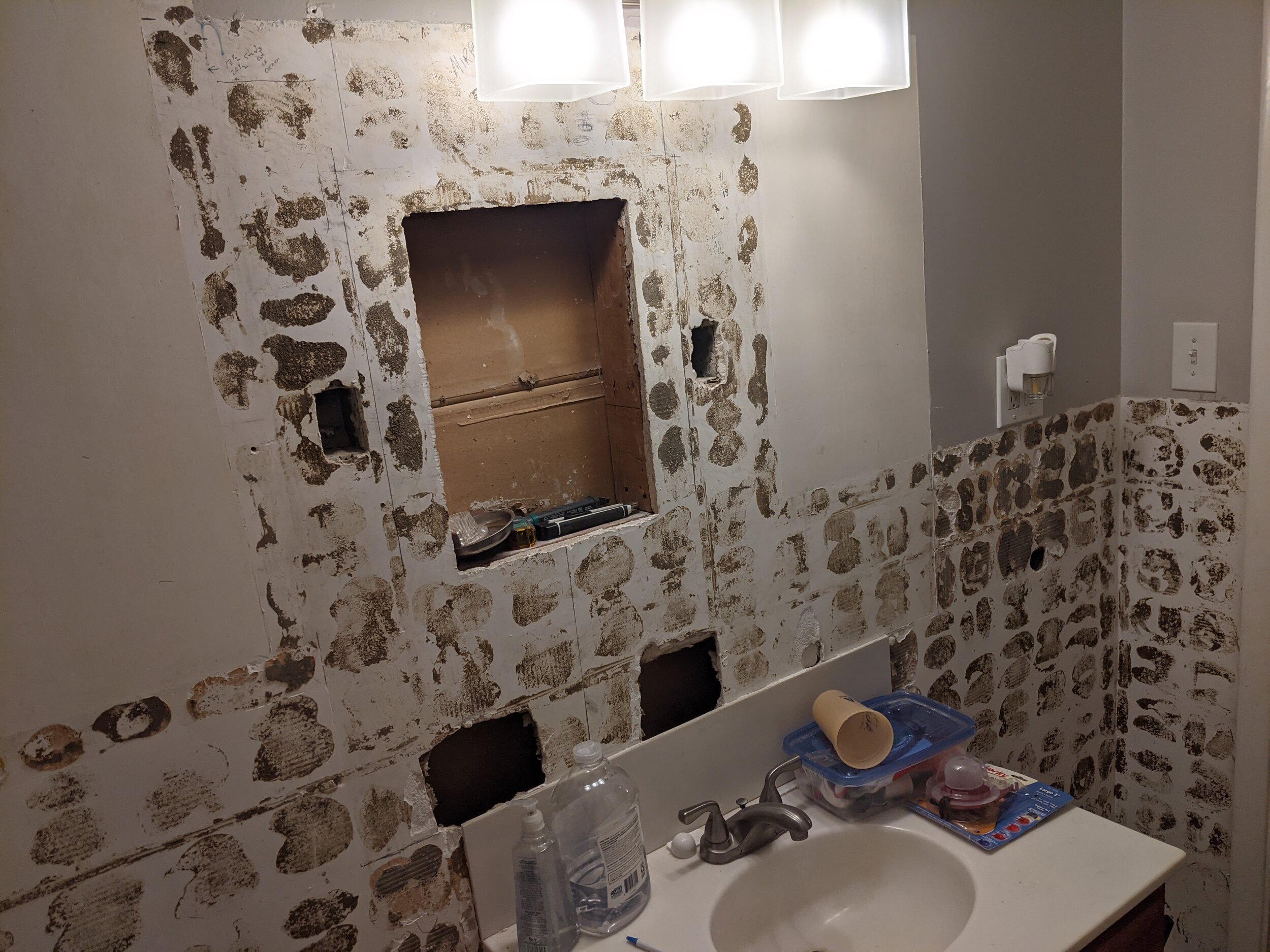
  • Take down the mirror

  • Peel off the remaining (hilarious) wallpaper

  • Discover that the mirror was hung over large, unfilled holes in the wall from an old medicine cabinet and soap dishes/toothbrush holders

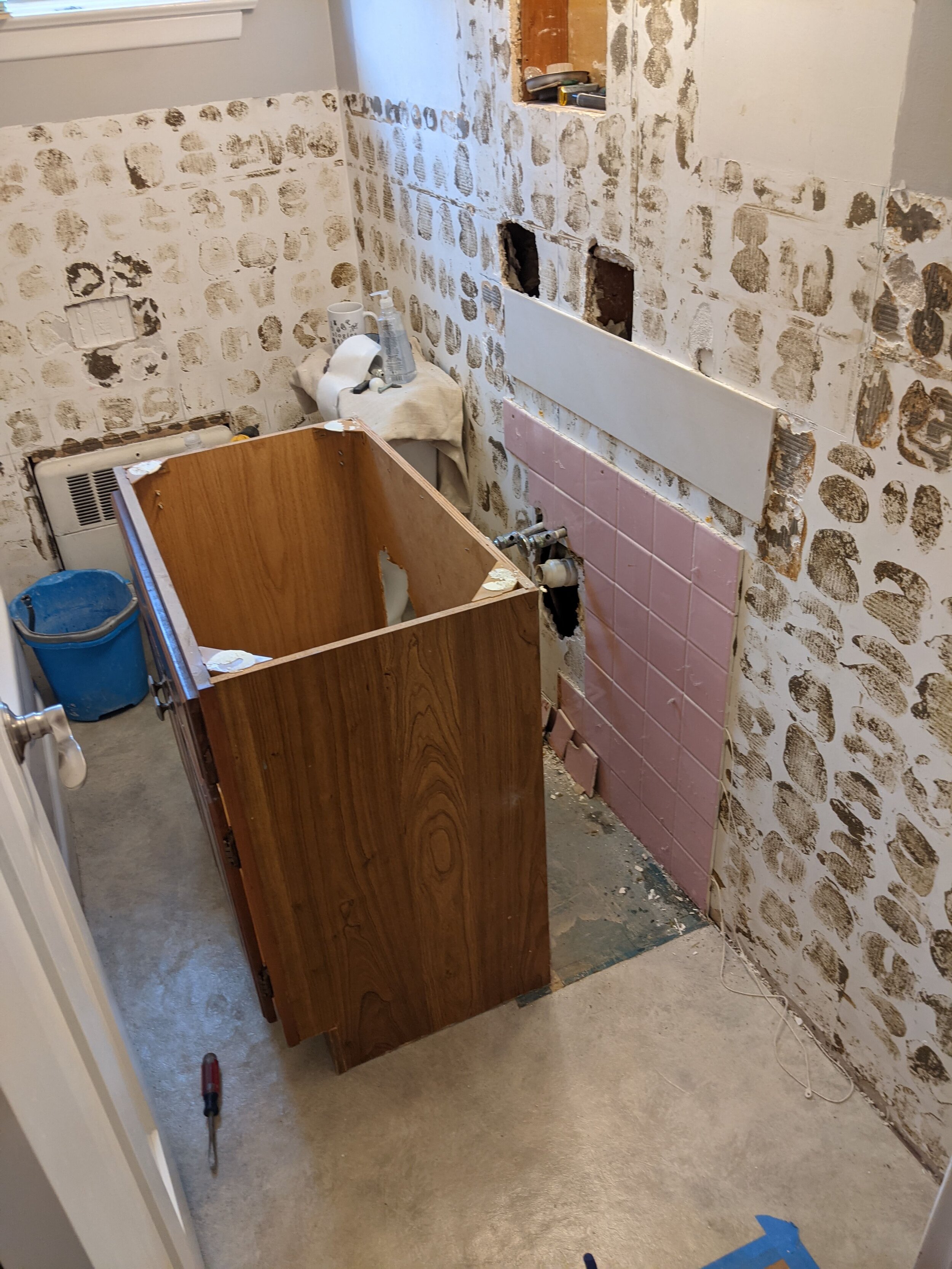
  • Remove the vanity

  • Remove the tub and plumbing

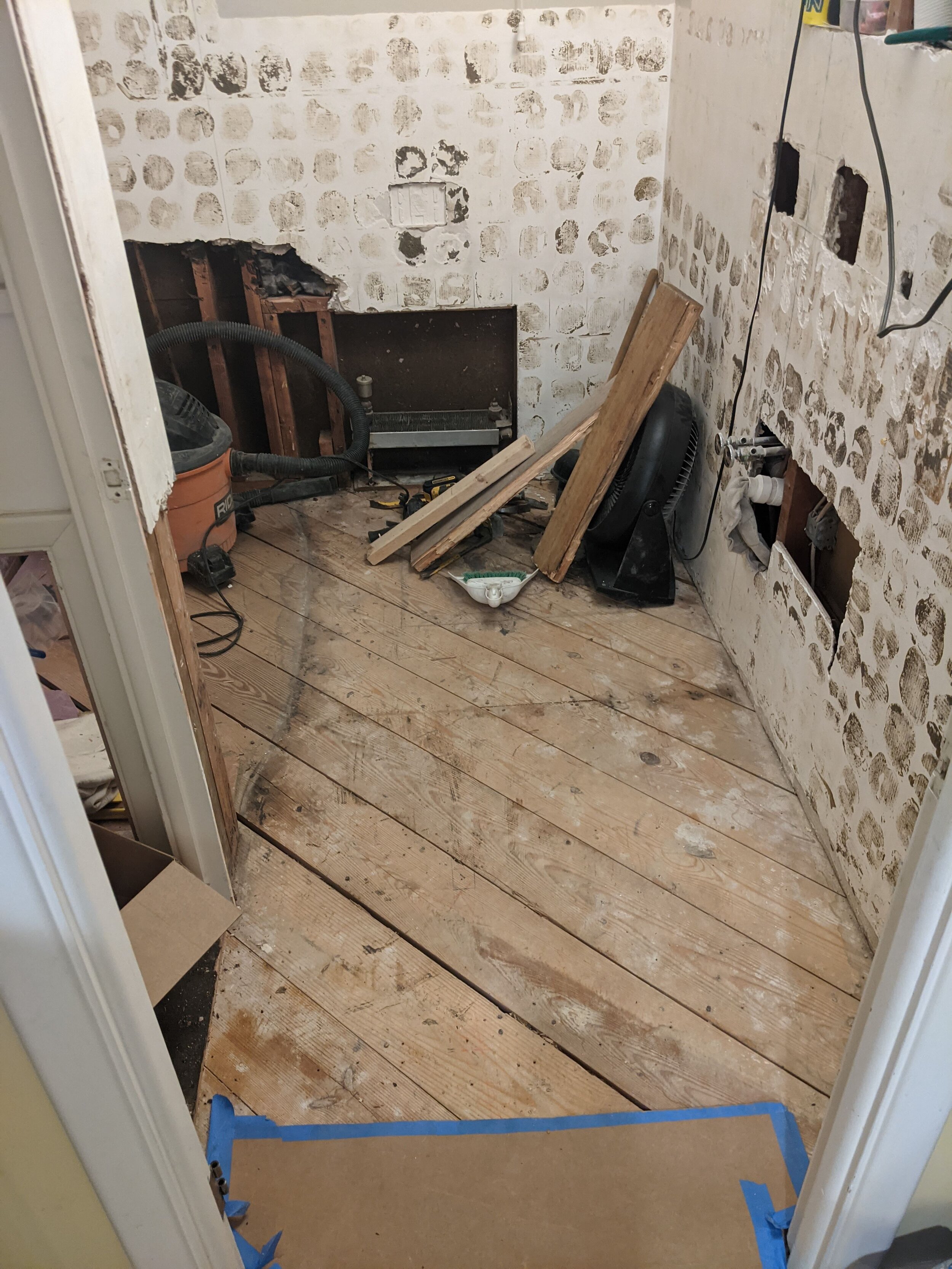
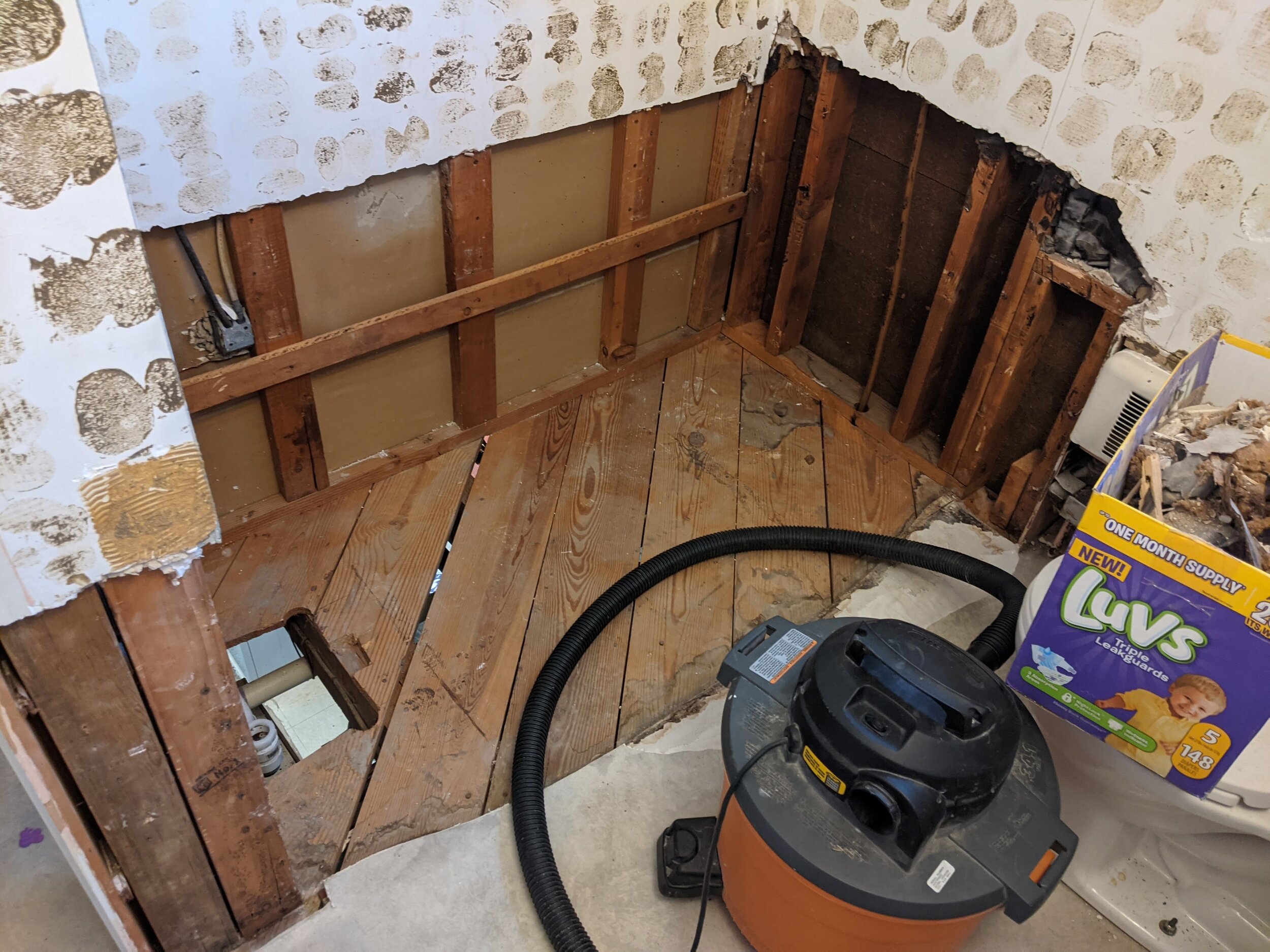
  • Pull up the flooring

  • Remove the toilet

Step One: Prep

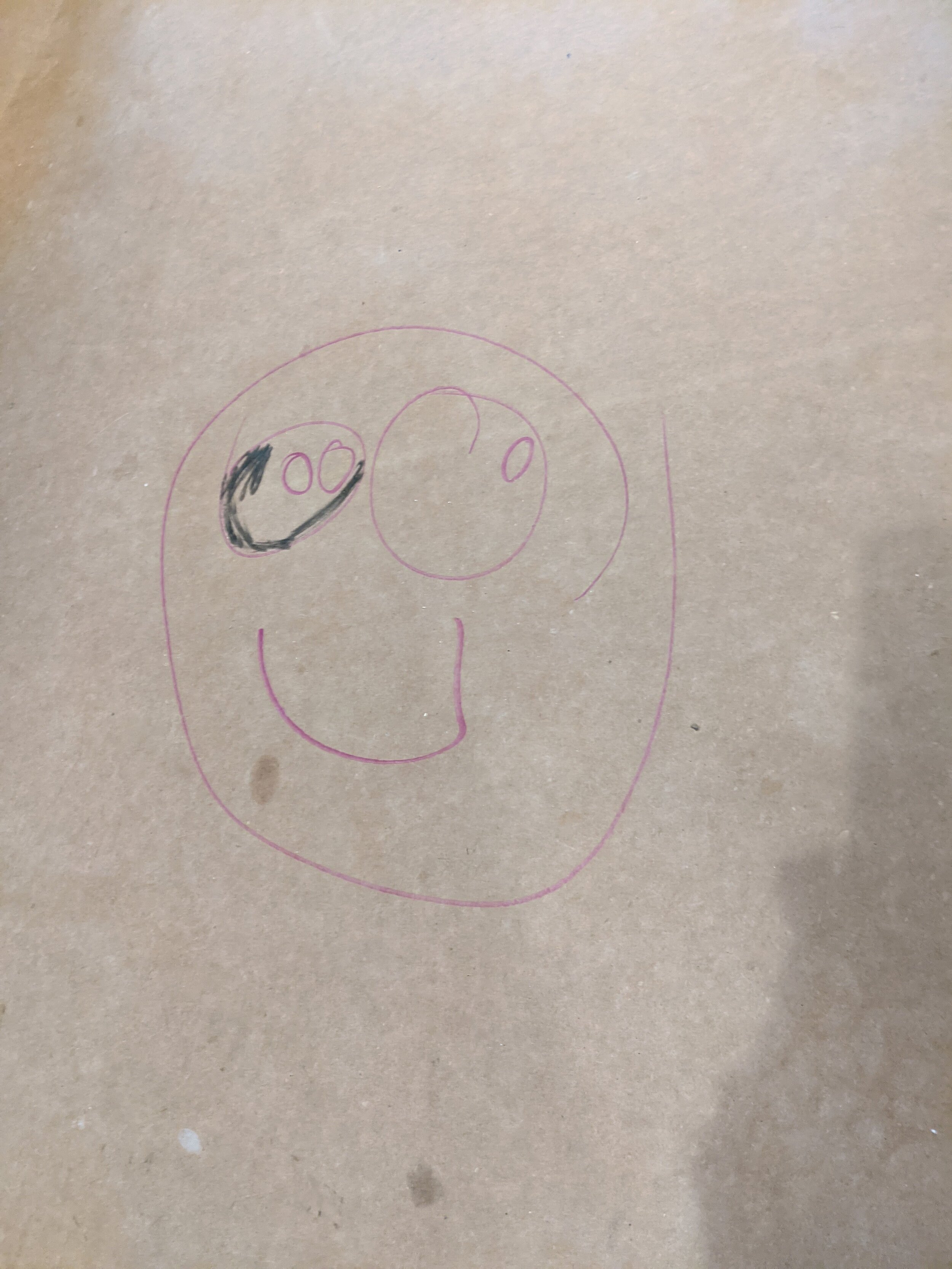
Protect. Your. Floor. if you’re carrying demo-ed materials through your house. It’s the best $30 you’ll spend. We used sticky plastic down the steps and thick parchment paper stuck on the floor with painter’s tape. Make sure your 8yo draws a winky smiley face on it to bring you good luck. This is a critical step.
Step Two: Kill the Old Tile

Demolition begins with knocking down tiles one at a time with a hammer and chisel, then moves on to the removal of furniture and appliances, then the ripping up of the floor. Do it slowly so you don’t damage anything (especially plumbing). If the wall is in good shape, avoid making holes that you’ll have to repair later.
Step Three: Remove the Large Items

Disconnect the plumbing and pull out the vanity. Discover more tiles. Cry briefly.
Step Four: Remove the Tub

After disconnecting the plumbing, we solicited neighbor help and lifted out this behemoth. The house has three full baths with a tub upstairs, so we didn’t need a tub here. We are converting to a shower stall. Unfortunately, the tub was chipping so it wasn’t really salvageable.
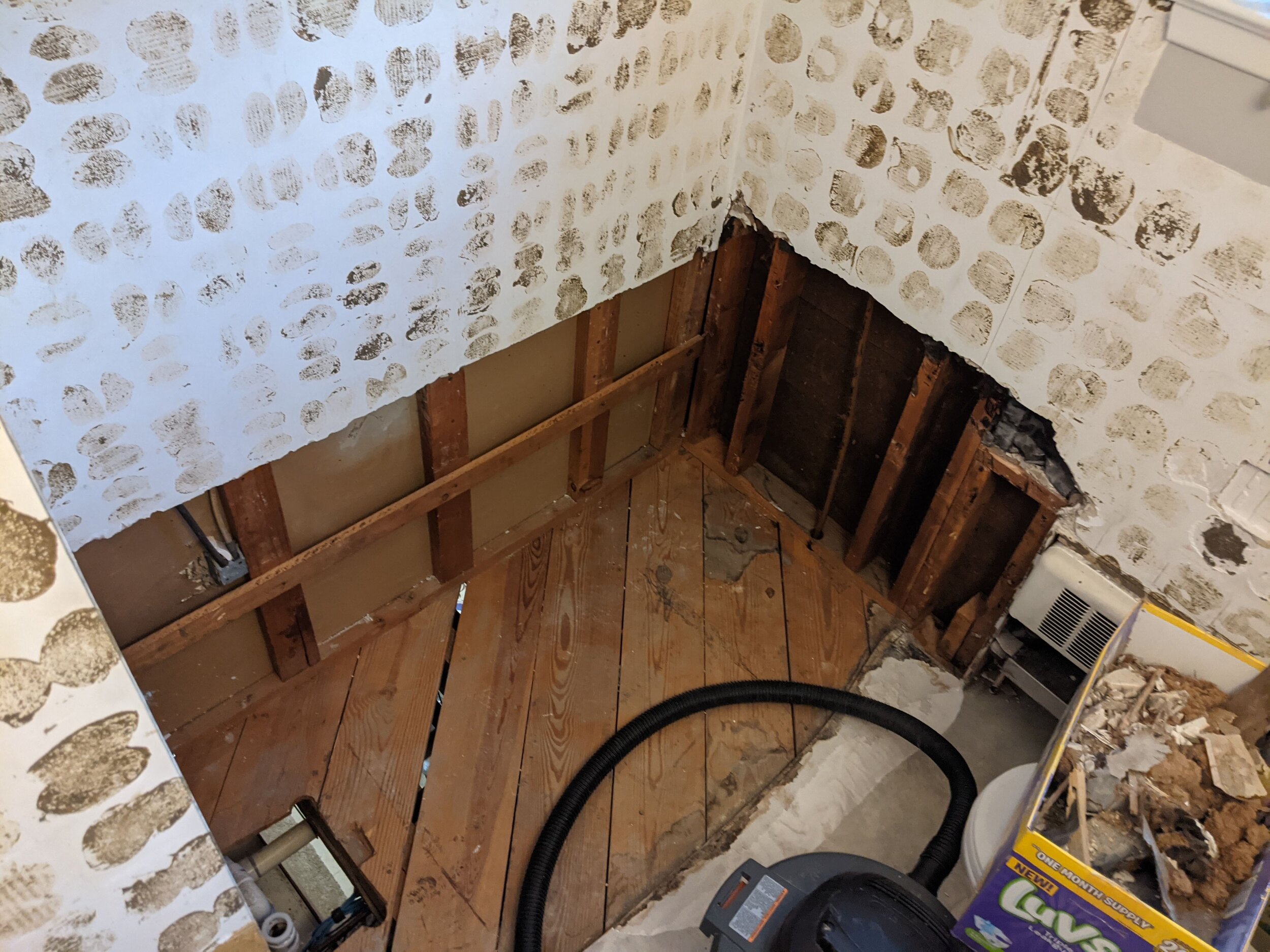
Step Five: Remove the Toilet

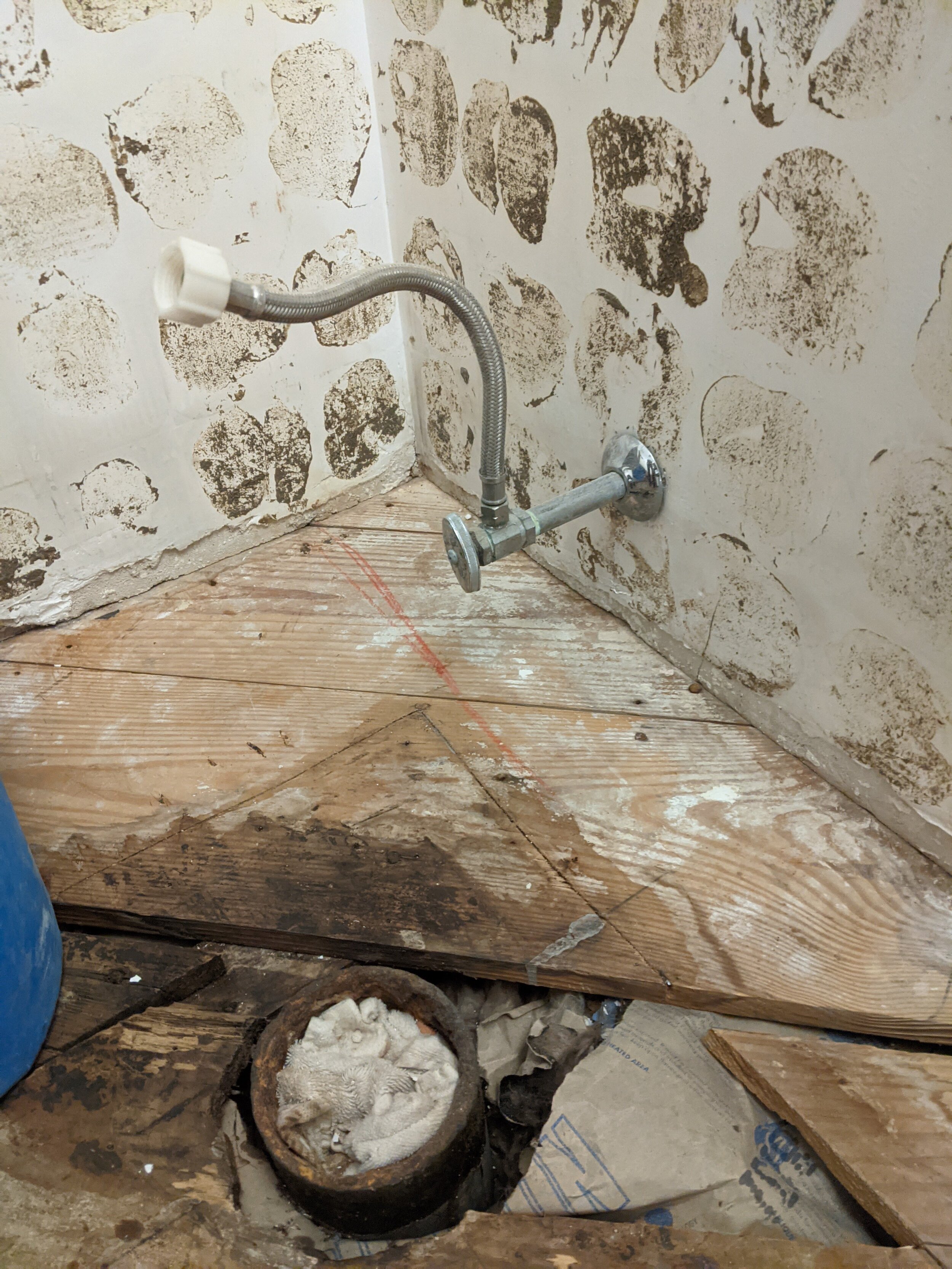
Again, disconnect the plumbing and remove the toilet. PLUG THE HOLE, PLUG THE HOLE, PLUG THE HOLE. That smell. Stick a towel in that the moment you pull it. I did not take a picture of this. (You’re welcome.)

Mini Step

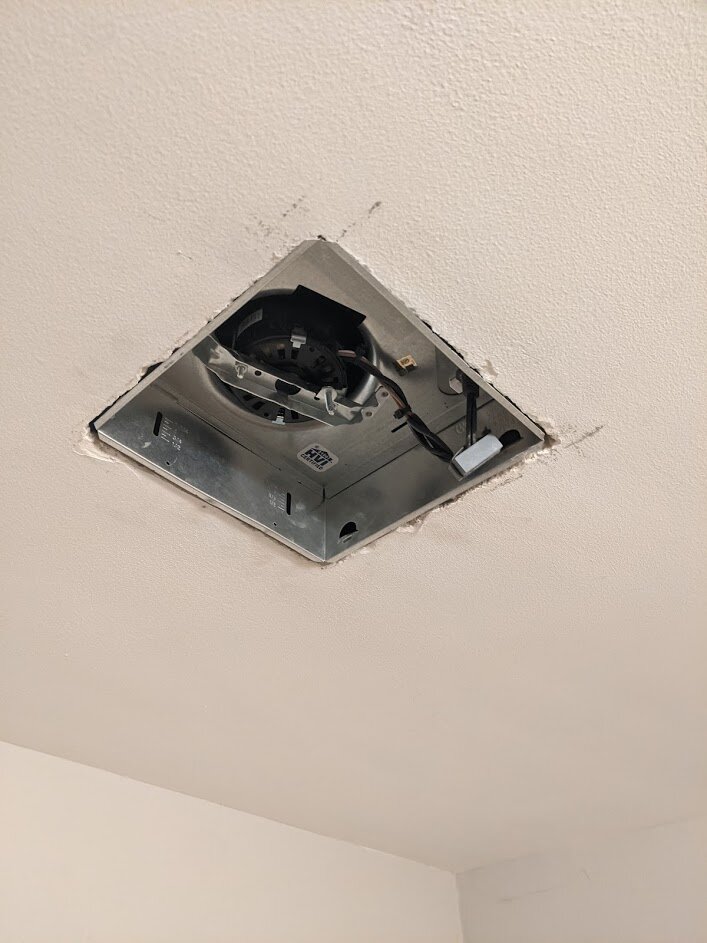
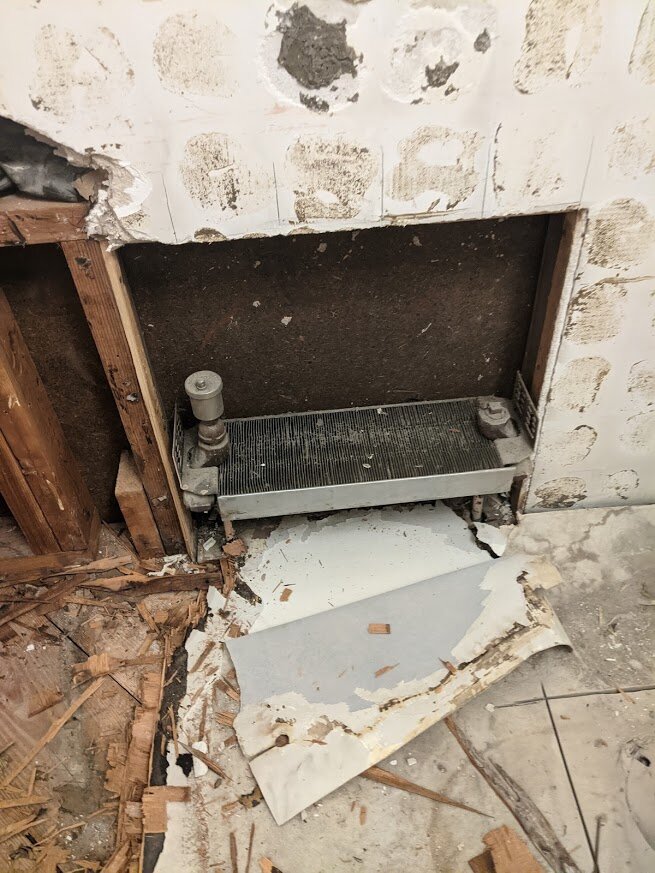
Our ceiling was ok, so we added the guts for an awesome light and vent fan (done at this stage because it would help clear out smells from our work). We also removed the wall heater at this point. More on the heater later.
 
PXL_20210124_210310869.MP.jpg

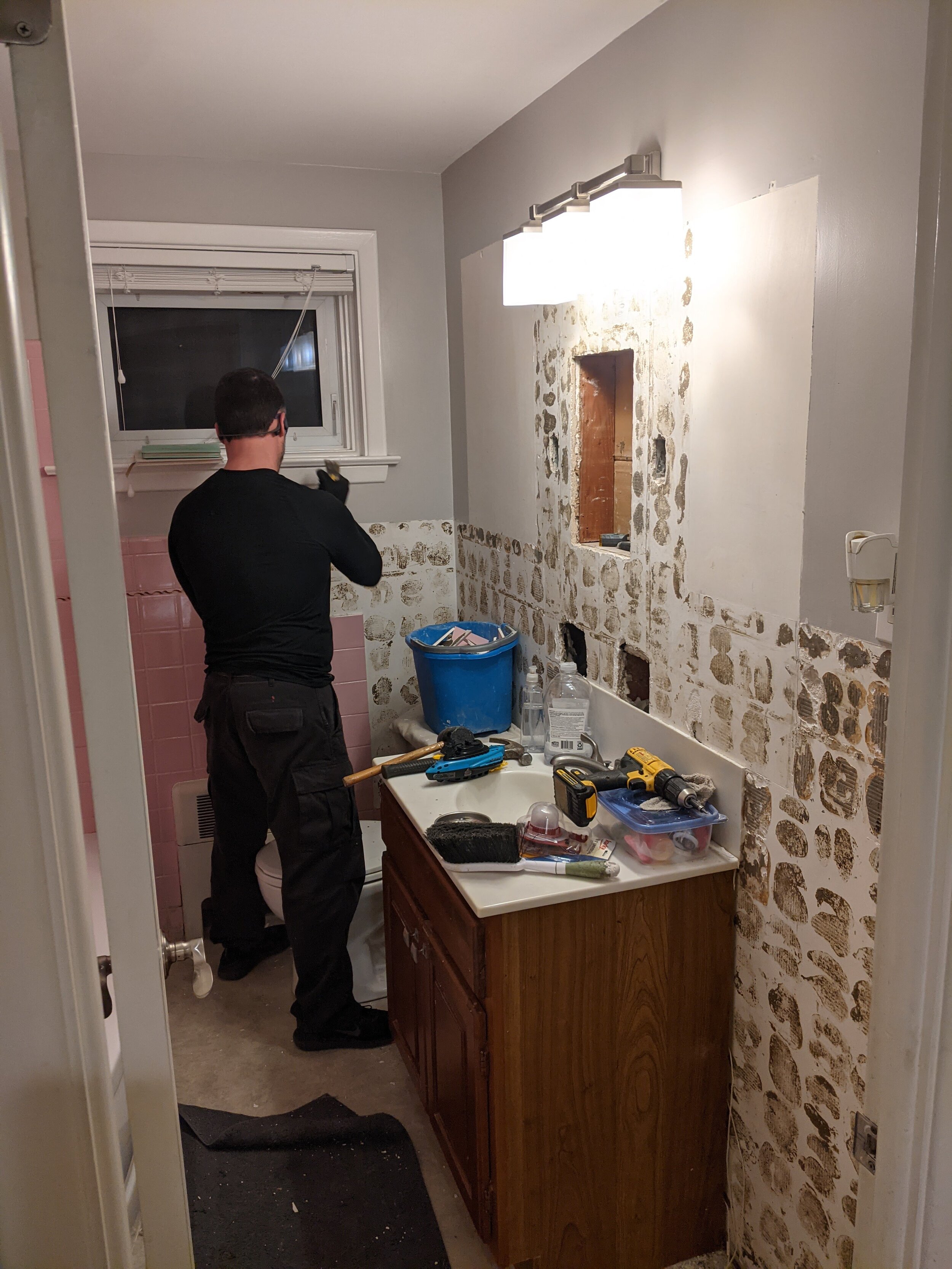
Step Six: Scrape the gunk off the wall until your fingers cramp into giant clams forever

Ok, maybe not forever, but we did include the kids in this process since it was so labor-intensive. Surface prep is critical. You want the tiles to adhere effectively and you want the paint to look smooth. Our oldest is 11 years old and a really dedicated worker and likes spending time with Hubs. Notice the ear protection, and of course his eyes are covered by his glasses. Hubs’ are on his head. (D’oh.)


Step Seven: Pull up the Flooring

We’re almost to a blank canvas! We knew this floor was lightly glued linoleum, because we’d laid it ourselves in a stopgap mini-renovation a few years before. But the top layer of subfloor had to come out, too, to ensure it was a flat and non-squeaky surface to tile.

This was a HUGE part of the process. It took a really long time, but this is one of the boring, unsexy steps that can take your bathroom from ‘oh you upgraded your bathroom’ to ‘I’m sorry, you did this yoUrSelVEs?’ Surface prep, can’t stress it enough. You can’t just put lipstick on a pig. All the tutorials that say ‘paint your XYZ with zero prep’ are just fast ways to hate what you’ve done a month later. Do it right or pay the price.

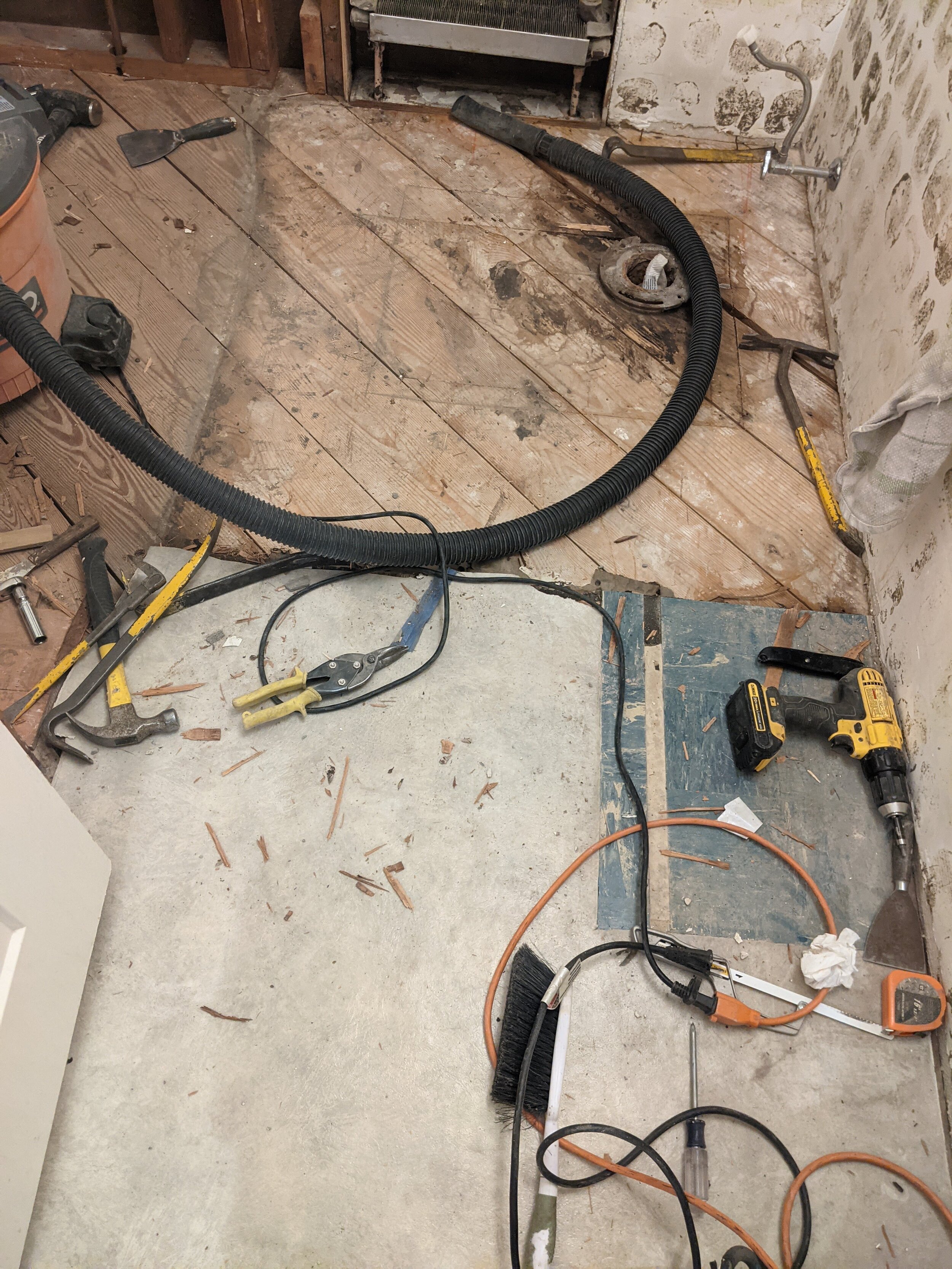
Demo done!

One the floor is out, we’re officially at the end of demolition in my book, because things (mostly) stopped LEAVING the room and started coming INTO the room.

Next step — see where we started with the actual construction.


Click Here to View the Full Blog Archive.      


how to renovate that bathroom yourself and not hate it afterwards

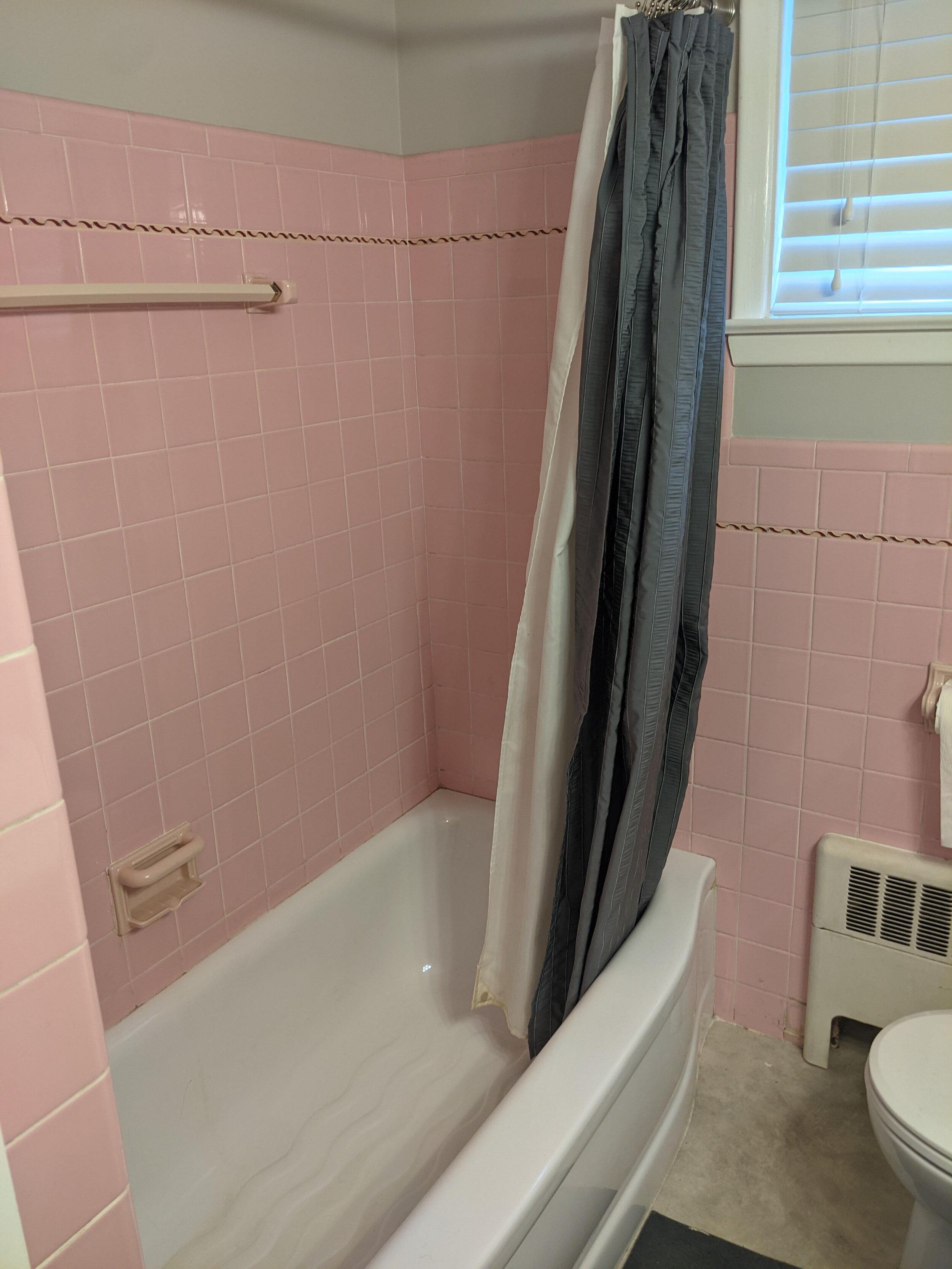
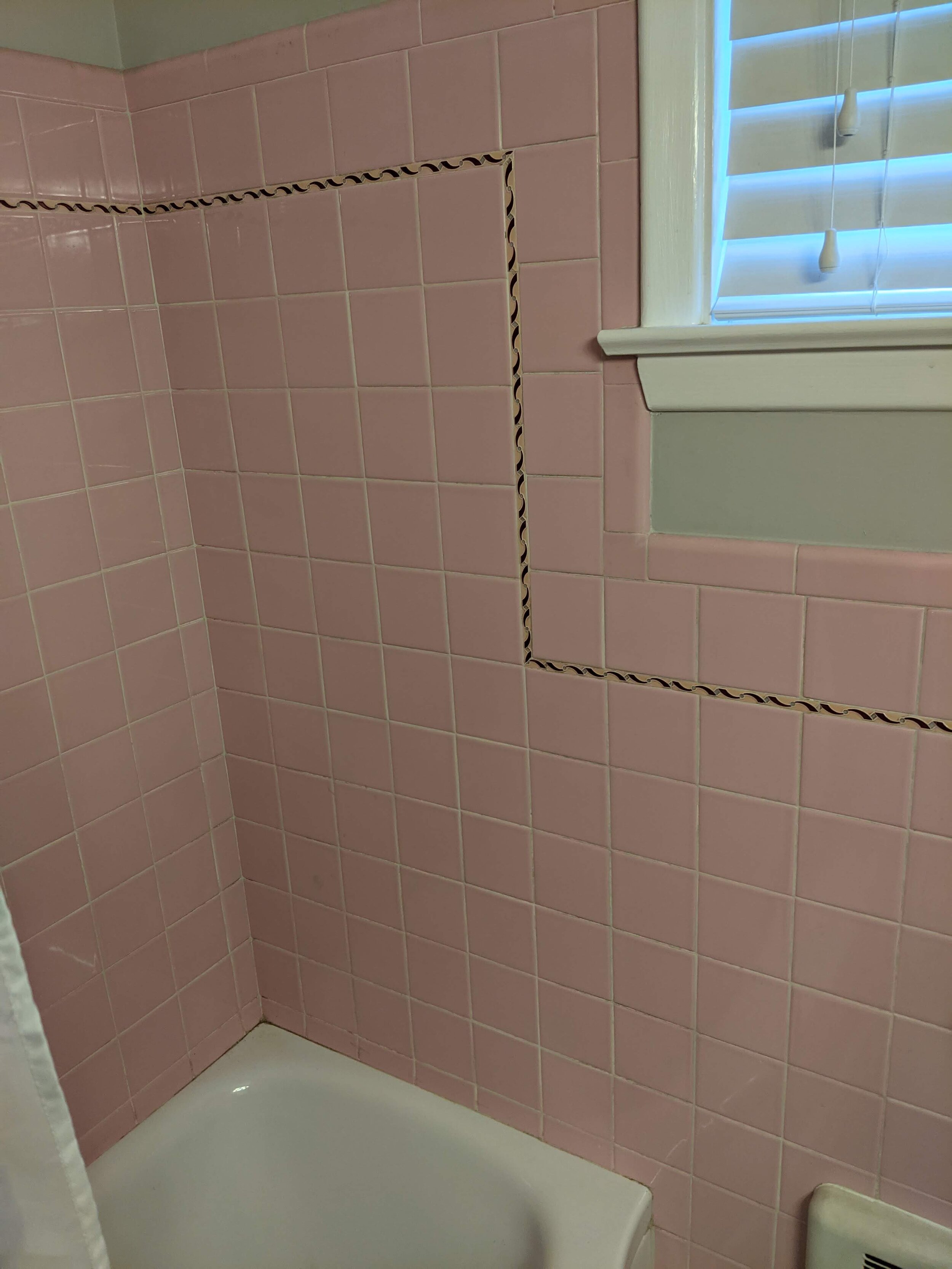
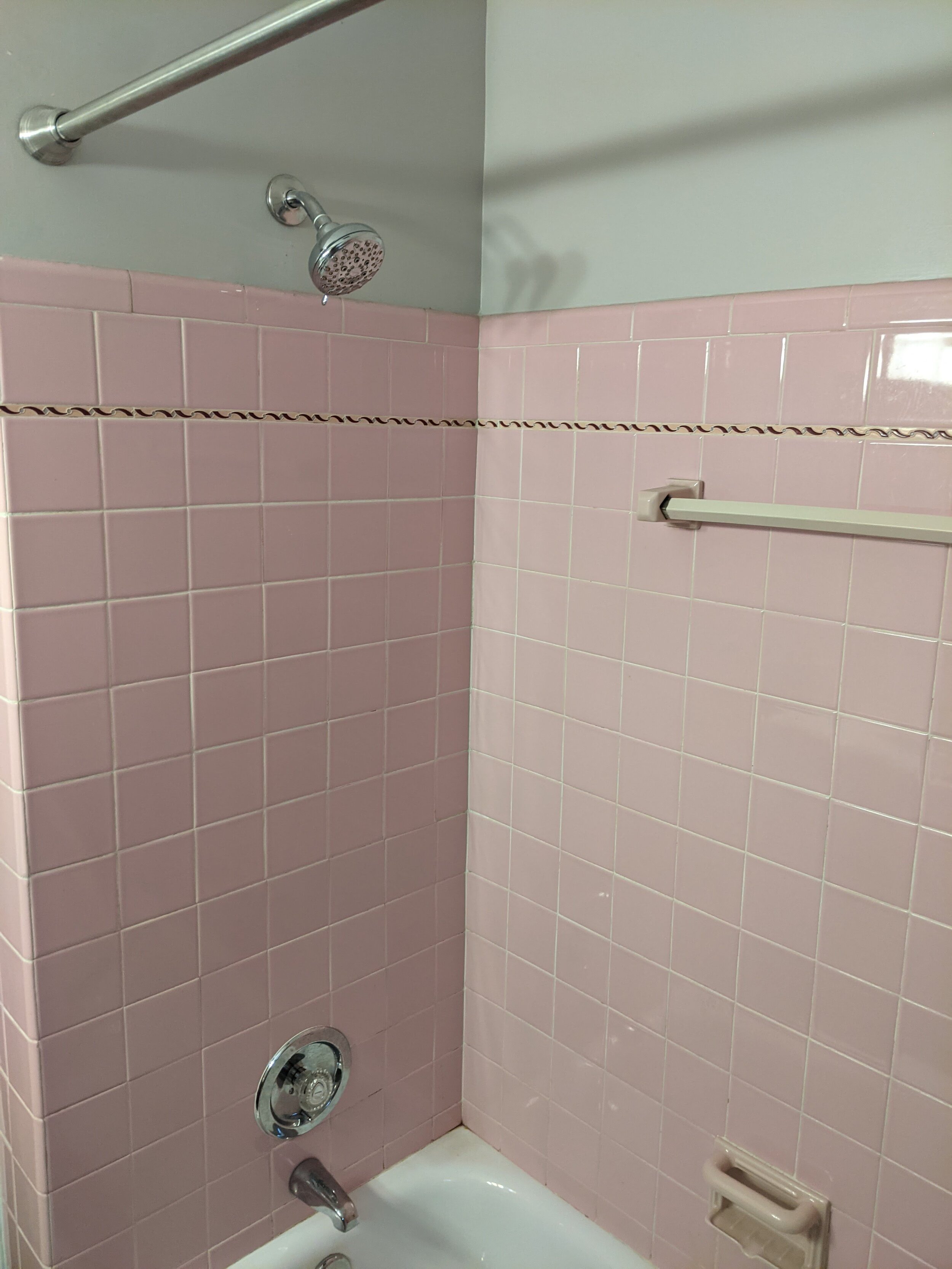
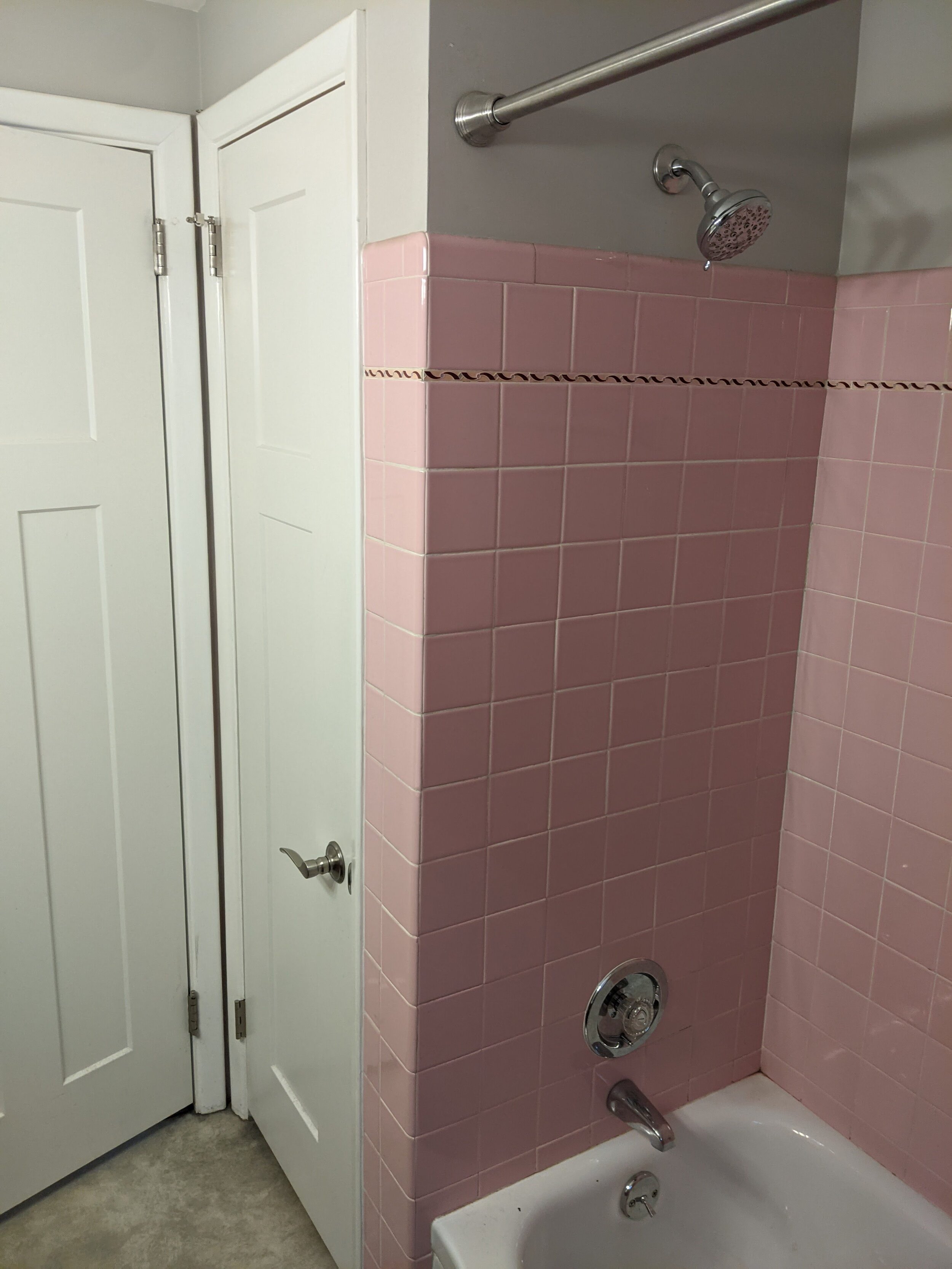
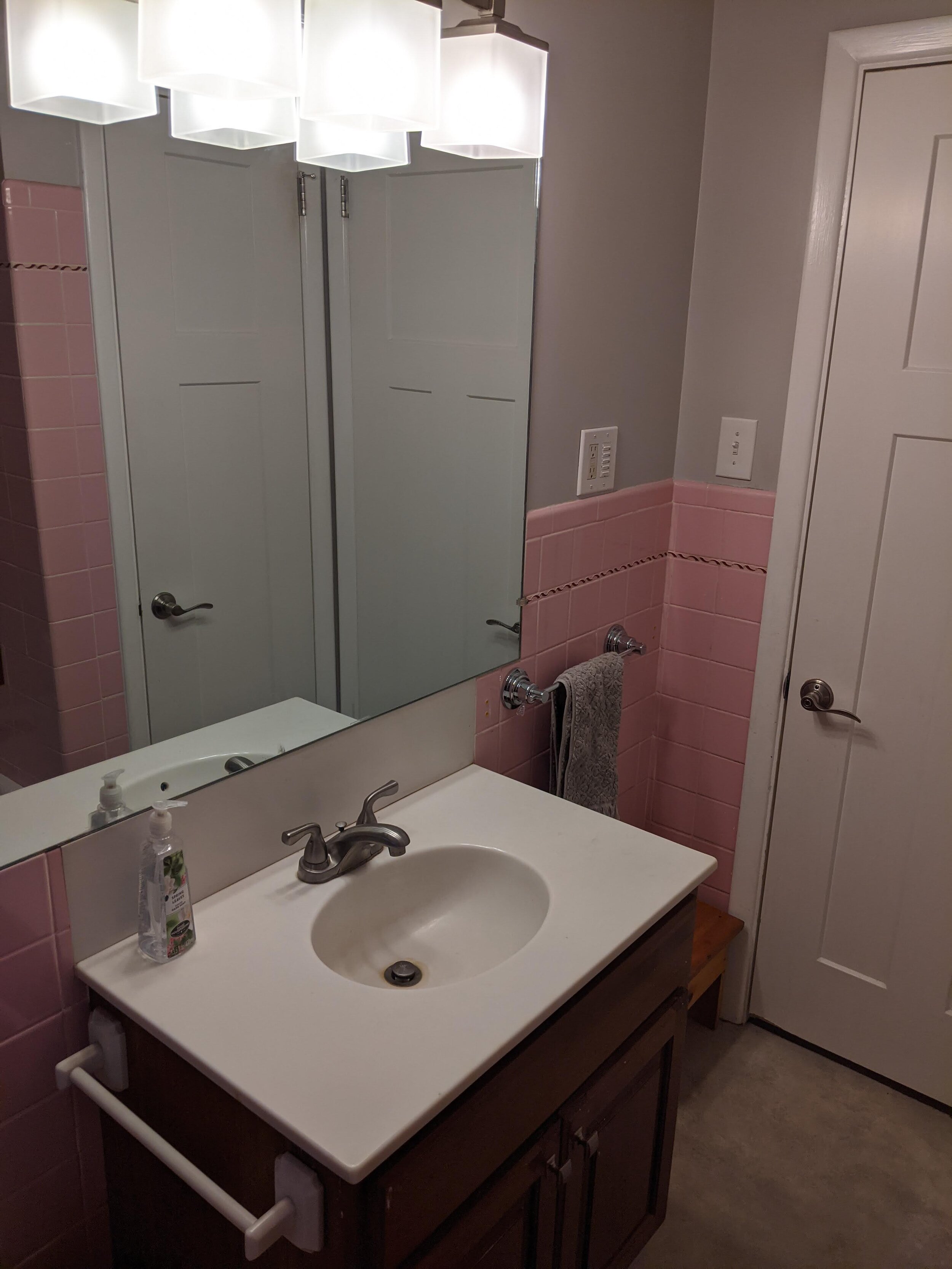
You might already know we documented the step-by-step renovation of our upstairs bathroom last year. This spring, we tackled the downstairs bathroom. The pink bathroom. Oye. Very glad to see this gone!

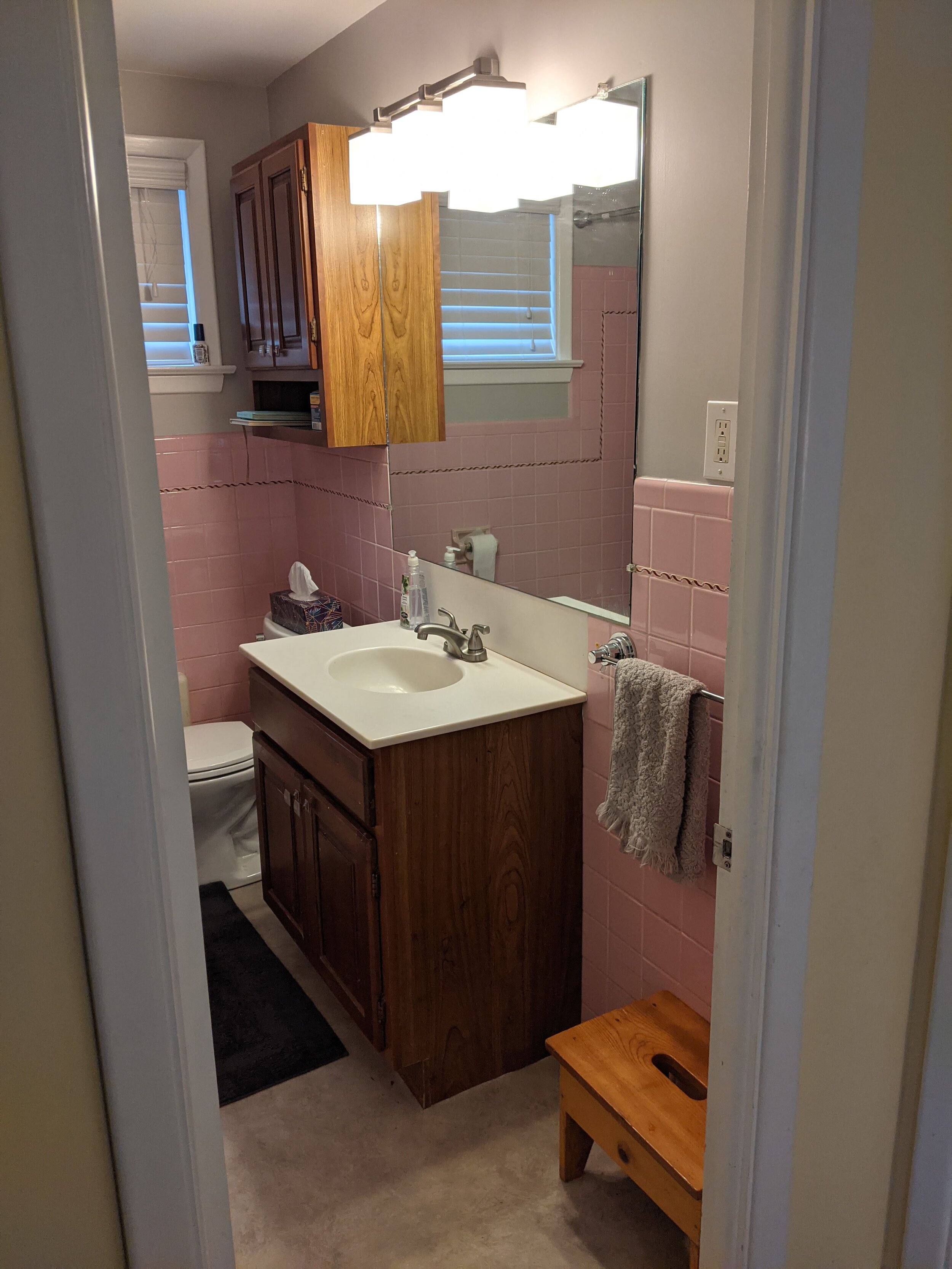
When we bought the house, it had wall-to-wall fuscia carpet in the entire first floor, which included this bathroom. That came out right away, and we replaced it with very cheap, quick linoleum which has remained for about 8 years. We also peeled down patterned wallpaper above chair-rail level to add some solid grey and replaced the light fixture. The dark shower curtain also helped tone down the color. A bit.

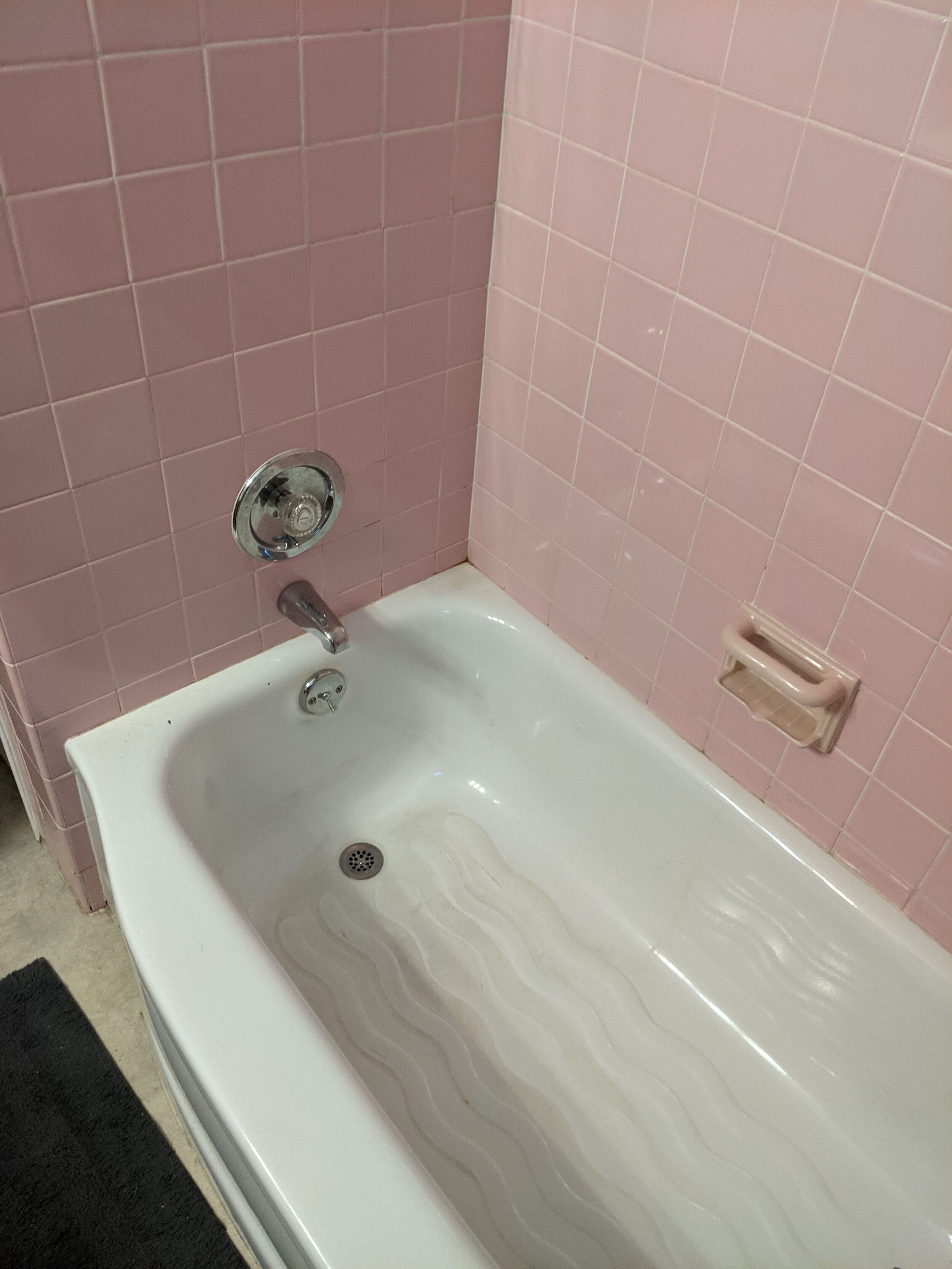
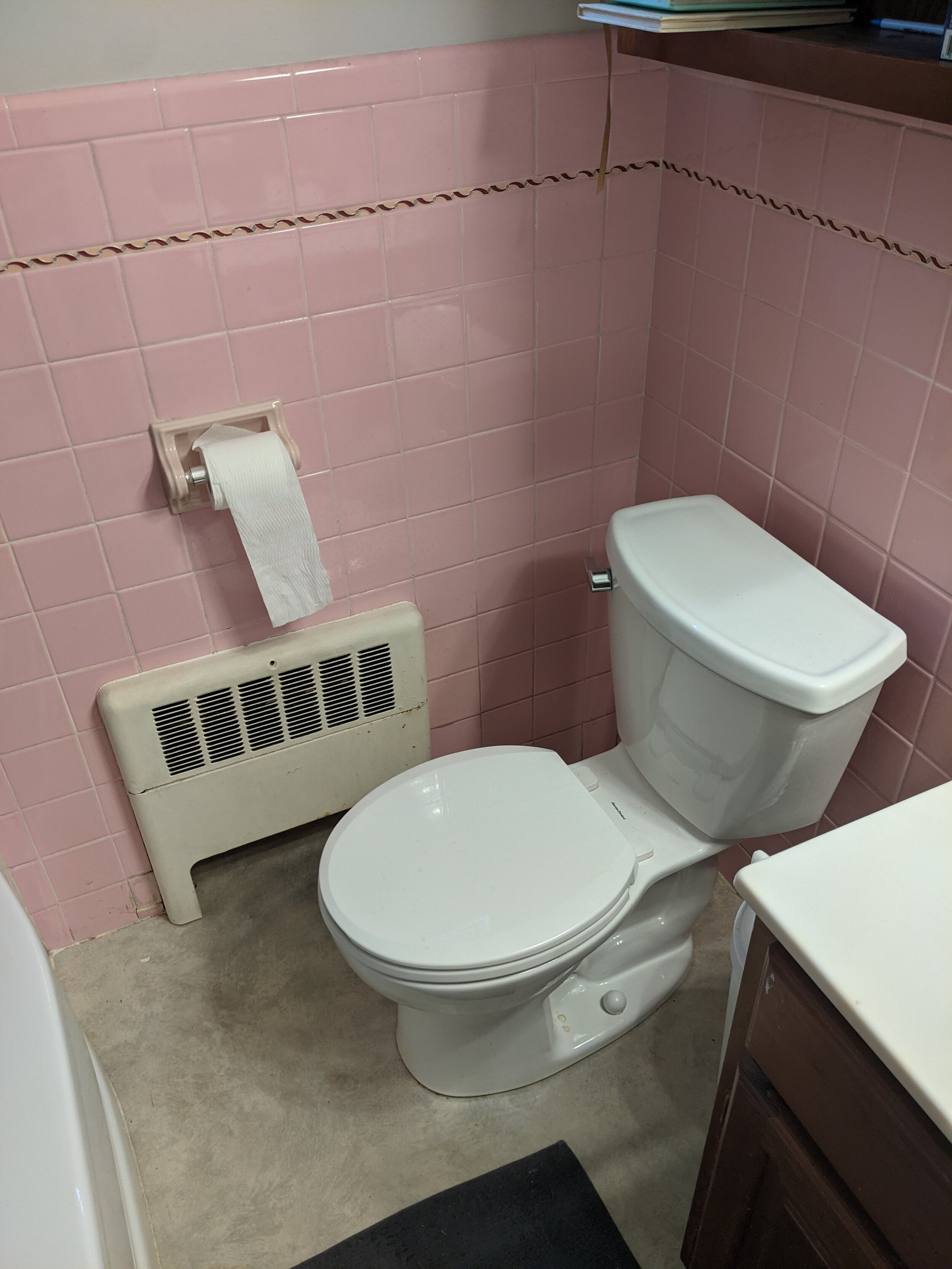
Here’s a good overview of the before issues:

  • Pink.

  • Vanity was too big and didn’t match the shelf (different shades of wood).

  • Heater was old and difficult to clean.

  • We have three full bathrooms, including a tub upstairs, so we didn’t need a second bathtub.

  • The kids had pulled off the built-in towel rack so we were using a suction cup one.

  • The toilet was too long and your knees bumped the shower when you sat down, even though it was a smaller, round toilet bowl.

  • Did I mention it was pink?

The first hands-on step (after careful planning) in any construction project, DIY or otherwise, is demolition. Keep reading to see if we can demo a project (the right way) with two elementary schoolers, a toddler, and a dog in the house — plus a flight of stairs to the dumpster.


Click Here to View the Full Blog Archive.      


I was his mommy once.

AdobeStock_386471428.jpeg

Real mom. Biological mom. Birth mom.

Foster mom. Resource mom. Adoptive mom.

We put labels on people like me. Over the last eleven years, I have been a mother to eight children, but only three children live in my house with me at the present time. What does it mean to be “mom” temporarily? Or to share the title “mom” with someone else? It’s complicated.

Well-meaning foster care supervisors will often tell foster parents to let a child pick what they want to call you. “Mom” or “dad” can be a loaded term, after all; best to let the child do what feels safe. But while that’s fine for a second grader or a tenth grader, that doesn’t really fit the bill for a child living in your house from 33 hours old until 33 months old, hearing other children call you “mommy” the whole time.

I remember specifically the first time a child who was not destined to be with me forever called out for me by that precious name. “Mommy!” I remember because I burst into tears. I was keenly aware of all she (his first mom) was missing. How heart-wrenching that she didn’t get to witness his initial yell of “mommy” – and how strange that it wasn’t for her.

How was I so lucky to be the object of this child’s love? To be the bearer of his trust?

One of the best quotes I’ve heard related to foster or adoptive parenting comes from Jody Landers, the author of Love What Matters. She writes, “A child from another woman calls me mommy. The magnitude of that tragedy and the depth of that privilege are not lost on me.”

Being a mom is about more than praying for a child, helping with homework, wiping noses, bath time, laundry, meals, and kissing boo-boos. Those are the actions of motherhood, but to be Mommy is about heart. And that first mother’s heart has not failed in any case I’ve seen: not in the cases where a child has been reunited with a first mother, and not in the case where I have become forever mommy. Despite circumstances, despite overwhelming challenges, despite difficulties I cannot imagine—it has been a privilege to share being mommy with these women.

The mother of a special guy who was with us for quite a long time has brought him back to visit us several times. My heart is full to see their thriving family. She has always been his mommy, and I’m just Kelley now. But I was his mommy once, too.


Click Here to View the Full Blog Archive.      


book review: the four winds

download.jfif

Kristin Hannah is rapidly rising on my list of favorite authors. The Four Winds was another masterpiece, just like The Great Alone. (Although I still liked The Great Alone more and even though she wrote The Nightingale that I didn’t like.)

My sister-in-law (who is my primary book dealer) dropped it off without a dust jacket so I literally had NO idea what I was reading. I opened the book at 9:11 and thought, “Let’s see what this is about,” and the next time I looked up it was 12:04 am.

If you want more proof that her writing is compelling, the story itself is actually sad — even slow-moving at the beginning — but that’s not what you’re here for. It isn’t about action and a sweeping fast pace… it’s getting to know these characters. And there is MUCH character to be known.

Unmarriagely six-foot-tall Elsa gets pregnant and disowned by her family. The barely 18-yo (who marries her at 25 to “do the right thing”) means well, but it is his parents, particularly his mother, who are instrumental in shaping Elsa’s life. The book’s quick prologue comes back in a surprising way as a speech later in the book, a very lyrical glimpse into the life of women at a transformational point of history. The family farm is dead, the animals are literally dying, the topsoil is disappearing in horrifically electrical windstorms, no one can breathe, everyone is foreclosing, and there’s no way out. You can’t walk in the desert and you can’t get gas to drive without money, and you can’t get money without crops, water, food…

I learned that I knew very little of the Dust Bowl, with most of my reading of the 20s/30s centered on cities with mention of suffering farmers in the Midwest. Wow. I obviously need to read The Grapes of Wrath. The storms, the government’s lack of response, the shocking classism/regionalism/refugee-ism (you can’t say racism in this context so blend those pieces together and you’ll get my concept)… the pieces all work together to really make you feel for the family. I appreciated that, while the son is a plot device to make the reader sense death is always moments away, mother-daughter conflict is a central focus.

Learning to accept yourself instead of basing your self-image on other people’s opinions is strongly emphasized as well. There’s a great deal of self-discovery plus blossoming inner strength. The story is compelling and believable.

A few warnings: part of the protag’s self-image centers on her parents always telling her she’s weak and unattractive, so her relationships with men are focused on at certain points. There are (very mild) descriptions of a few sexual encounters.


Click Here to View the Full Blog Archive.      


book review: the extraordinary life of sam hell

download.jfif

Sam Hill was born with bright red eyes (ocular albinism) and got his name when Mr. Hill walked into the hospital room and yelled, “What the sam hell is wrong with his eyes?”

The Extraordinary Life of Sam Hell by Robert Dugoni follows Sam from birth through years of school bullying until he reaches a stage of somewhat normalcy thanks to two special friends who also stand out (one for being the only black kid in a Catholic school and one for being a troublemaker with a good heart). He becomes an eye doctor on the mission field, worldwide, helping children with special vision needs. Ultimately, when he returns home, he is able to undo some damage from the past and bring some healing to places it was needed.

This story surprised me in so many ways. First, a very thoughtful approach to faith since a huge portion of the story revolves around his mother’s steadfast Catholic religion and the religious schools he attends. So refreshing to read a story where people are people — three dimensional with good qualities and mistakes and irritating habits and redeeming moments. The story’s heavy faith component is important because Sam is able to see only with maturity that his mother’s trite sayings are deeply meaningful to her, and even get a sense for himself that his faith is still relevant to his everyday life. There’s a great revelation that faith is more than attending church or going to confession or doing a rosary, and that his mother’s desire to do those things isn’t really what embodies her faith. It might be all he can see, but he learns that she is greatly empowered by her beliefs.

I related strongly to Sam’s mom’s desire to protect her son from bullying but also to his father’s desire for his son to live a normal life. The friends he makes are believable even if the bully is not. (The bully is just a bully, because his father before him was a bully, and that’s really all you get.) I didn’t even start shipping him with the romance interest until partway into the book which I think is somewhat remarkable. You find yourself learning along with Sam how people relate to him authentically or inauthentically based on his ‘condition’ as his mother calls it.

Disclaimer: This book contains two sexual scenes. They aren’t long, but I always want to warn you when I’m reviewing books.


Click Here to View the Full Blog Archive.      


Another Casualty of the Pandemic: The Foster Care System

foster-pandemic-fb.png

In a “normal” year, 400,000 children are in the US foster care system. That’s 1 out of every 184 American children. The pandemic has brought havoc to this already overstrained system in an unexpected way.

While child welfare calls have gone down—for example, reports of child maltreatment in New York City dropped 51 percent in the spring of last year compared to the same period in 2019[1]—most experts agree kids are not safer. In fact, the heightened stress and insecurity of this crisis has likely increased abuse, neglect, and other factors that would normally necessitate intervention. But with schools, day cares, and community life closed or on hold, fewer mandated reporters and even concerned neighbors are interacting with kids who might be in need.

One county in North Carolina reported a spike in the number of children actually removed from homes in the fall of 2020, even though reporting calls were down 20%. Wake County Child Welfare saw an added, disturbing change: while 83 percent of removals are typically due to neglect, social workers found nearly half during the pandemic, 45% were because of abuse[2]. Fewer reports but more removals with a higher percentage of abuse paints a dreary picture of the life of the American child enduring this crisis.

A complicating factor for this catastrophe is many counties are reporting low numbers of foster homes. Working parents who aren’t able to be home with foster children when schools are closed, worries about spreading the virus, generally increased stress and uncertainty, the average higher age of foster parents, and other factors are making it harder for agencies to recruit willing families. For example, Dane County in Wisconsin has 385 children in foster care, but only 165 foster homes—their lowest number of homes in the last decade[3]. Stark County Children’s Services in Ohio reported that 10% of the foster parents on their regular roster are no longer able to take in new children at this time[4]. Nationwide, scattered reports from desperate agencies echo more of the same: dropping numbers of foster parent applications.

Additionally, with courts limiting procedures or even temporarily closing, more children are staying in foster care instead of being granted permanency (whether via reunification with their family or through another permanent resource).  For example, in California, almost 4,300 fewer children left foster care between October 2019 and September 2020 compared with the same time frame a year earlier[5]. A child’s average stay in the foster care system is already over a year[6], and extending that time only further stresses the system and each individual child’s development.

Older children in foster care, particularly those who are aging out of the system or nearing that age, are not immune to the economic and emotional impact of the pandemic. One in four 18- to 24-year-olds who are (or were) in foster care experienced heightened food insecurity since the pandemic began. In addition, about 40% were forced to move or feared having to move, nearly 33% said they only had enough money for a week or less of living costs, and 27% of transition-age foster care youth lost their jobs because of the pandemic[7].

So, what is your calling to the hurting kids of our country?

Most experts agree that an overwhelming surge of kids is about to hit the foster care system. As restrictions are lifted and more sunshine enters dark places, abuse and neglect that has been hidden for months is going to expose the needs of an unprecedented number of children.

But the question we face is not, “What can our nation do to help hundreds of thousands of children?”

The question is, “What can I do to change one child’s life?”

 
foster-pandemic.png
 

[1] Administration for Children's Services

[2] WRAL, https://www.wral.com/19522214/

[3] NBC15, https://www.nbc15.com/2021/01/06/fostering-through-covid-pandemic-brings-foster-care-system-families-new-challenges/

[4] MSN, https://www.msn.com/en-us/news/us/pandemic-shortage-more-foster-families-needed/ar-BB1cPj97

[5] California Child Welfare Indicators Project

[6] 14.7 months, childwelfare.gov

[7] Foster Club study, March 2020


Click Here to View the Full Blog Archive.