what to ask with a newborn foster placement

newborn-foster-placement.jpg

A friend got a call today that she’s getting her first placement as a foster parent: a newborn baby boy. Her questions made me want to put together a list of suggestions to ask if you’re picking up a newborn. These are different than the questions you might ask for the placement of an older child.

How much does baby weigh?

You might think this question matters to help you pick up the right diapers (and it does), or to know what size clothes to get (also key). But the reason this is specifically relevant to newborns is the car seat. Both hospitals we’ve picked up babies from have a social services staffer who checks the car seat against the child’s weight. For example, if the baby is 4 lb 8 oz and your “newborn” car seat is labelled for 6-30 pounds—they won’t let you leave. Our favorite infant car seat is the Chicco Keyfit which is labelled for infants down to 4 pounds (which we’ve had several times). Find out the current weight (not the birthweight since babies almost always lose weight for the first day or two after birth) particularly if the baby is a preemie or IUGR (intrauterine growth restriction) due poor material nutrition.

What is baby eating?

If baby is eating breastmilk from birthmother or from a donor, ask the hospital how much they will send you home with. Then (following their instructions), try to mix it with formula to make the transition easy. If baby is already on formula, ask what brand and which selection so you can get the same and transition slowly to whatever brand you prefer. Better to avoid discovering on your first night that the orange brand gives the poor baby gas!

Is baby using a pacifier?

Sometimes newborns aren’t attached to a pacifier yet, but if yours is, better to ask than be helpless. Find out exactly what brand and size the hospital is using so you can get a few.

When will baby be discharged?

You might get a call on Monday morning, but depending on when baby was born and depending on his/her circumstances, baby might not be ready to come home for 24-48 hours. Ask if they have an estimate on when the hospital typically discharges babies so you know what to expect, then be flexible. Better to ask so you aren’t surprised by either rushing or waiting.

Has baby boy been circumcised?

The reason I tell you to ask this is that you may not change the diaper during hospital pick up, and the process for diapering a boy who’s had this procedure is a little different (Vaseline and sterile pads, angled right or you just get a flood out and over the diaper!). One of the little guys we had experienced some complications during the surgery, and I’m glad that we had already talked to the doctor about what went wrong during the procedure (or I might have had a heart attack).

Just like you would with all foster care placements, I’d also ask about family medical history so you can prepare, about visitation expectations (state date, frequency, length), and about what kinship options are being explored.

Happy parenting!

Foster Care and Social Distancing

Foster Care and Social Distancing

What happens in a foster care home evaluation?

What happens in a foster care home evaluation?

Foster Parent Wish List

Foster Parent Wish List

 
newborn-foster-placement-v.jpg
 
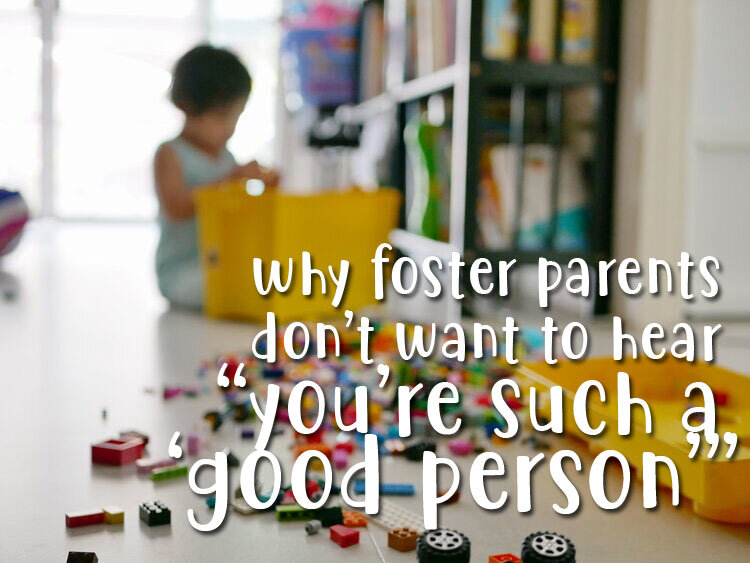
Why Foster Parents Don’t Want to Hear “You’re Such a Good Person”

Why Foster Parents Don’t Want to Hear “You’re Such a Good Person”


Click Here to View the Full Blog Archive.      


"you're such a good person"

I’ve been a foster parent for almost 7 years now.

foster-parents-such-a-good-person.jpg

I don’t say that to impress you. In our agency, our longevity is hardly impressive. There are families who have foster parented for decades and had untold dozens of children in their care. I’m just telling you that I’ve had some time to reflect on typical conversations.

A friend of mine who is just starting out as a foster parent texted me yesterday.

Any advice on how to respond to people who say things like "you're such an inspiration" "you're such a blessing to her"?  I feel like I want to answer/correct with paragraphs which is rarely appropriate the situation so I end up just keeping my mouth shut?! 

Since I’ve asked heard this comment repeatedly, kicked myself after missed opportunities, and given more than my share of stumbling, horrible answers, I’m sharing my thoughts somewhat coherently here. Whether I’m equipping another foster parent with a helpful answer or helping someone else know NOT to say this, here is my response to this line of thinking.

But first! Before I get into what I think is a good answer, I want to admit what I think was a spectacular but hilarious failing of my own. Picture me at the gym, sweaty post-workout, and corralling multiple humans, some who look like me and some who do not, toward the door. Someone is wearing their coat backwards, someone has their face in a book (about to walk into a doorframe), and someone just wiped their nose on my shirt. I’m at the gym a lot, so people know me, and people have gotten to know that we are foster parents.

  • Person: [smiles, waves, touches baby’s cheek] You’re definitely going to heaven for what you do for those kids.

  • Me: Ahhh. Uhh, ok, I don’t think that’s how that works. [walks off awkwardly chuckling]

Terrible theology aside, there was a chance for me to lovingly direct the person to consider the implication of their comment. Instead, I’ve been kicking myself for weeks. “I don’t think that’s how that works? Come on, Kelley!” [facepalm]

So, is there something WRONG with telling a foster parent they’re ‘a good person’ or ‘an inspiration’?

First, thank you for meaning something good. There are deliberately mean comments you could make, so I’m always going to give you the benefit of the doubt for trying to be positive. But unfortunately, let’s think about what you said. I don’t think you’ll like it.

The implication behind your statement is: That child is an unwanted burden. Even if you didn’t think that when you said it, you don’t look at someone with a delicious chocolate ice cream cone and tell them they’re a good person for eating it. You don’t tell the average person he’s an inspiration; you say that to the person facing cancer. Saying I’m a good person means I’m handling an undesired task so the rest of you don’t have to. And that’s not what I’m doing.

But, wait! You are! Nope. Not a cause. Not a task. You go tell the executive director of our agency that he’s a good person. Go tell the caseworker she’s an inspiration. Go tell the CASA he’s going to heaven. Because they are involved in a cause. I am parenting a child. And children are a gift, made in the image of God. And I’m honored to have whoever God sends me to care for in this home.

So, here’s the good answer I try to formulate when people say this:

“Actually she’s an awesome kid, so we think we’re the lucky ones!”

This gives them a moment to realize they just implied that a child (who is often standing right in front of them) was some form of hardship, a burden. Something society needs cleaned up. From experience, I’ve seen this response can change their perspective without correcting them, and sometimes they actually offer a follow-up that’s more appropriate.

Be impressed when people fight for a cause. In fact, become a CASA! Raise money for a foster care agency! Be that good person! But if you’re talking to me, I consider what I’m doing a privilege. You don’t need to thank me, be impressed by me, be inspired by me, or think I’m a good person. In fact, it’s so great! Let me talk to you about why you should pray about being a foster parent, too.


Click Here to View the Full Blog Archive.      


book review: The Invention of Wings by Sue Monk Kidd

81hTbnROjvL.jpg

Obviously, I’m the only person who hasn’t read The Secret Life of Bees, but I did read The Invention of Wings. I was very intrigued by the story of the Grimke sisters, who seem to be feminists and abolitionists born before their time. Born forty years later, and they’d be celebrated like Elizabeth Cady Stanton and many other prominent historical figures who they greatly influenced. (This story is a fictional, but plausible story of the older sister Sarah’s life.)

Handful is a slave ‘given’ to Sarah as a birthday present, and their relationship changes the course of Sarah’s life. Years later, under Sarah’s influence, her sister would pen the groundbreaking pamphlet An Appeal to the Christian Women of the South. At least according to the novelization, the women were on the course to greater influence when they began attracting too much attention in the form of men (instead of just women) attending their rallies. The offense of being feminists in addition to abolitionists caused even their beloved Quaker church to abandon them.

The story includes a fair amount of deep sadness due to the content being heavy with a failed slave revolt, great abuses of slaves, and more. Handful and her mother Charlotte put a face on the first cause Sarah is fighting for—the abolition of slaves. Her powerlessness to free her friends or even help them is part of what makes the connection between abolitionism and feminism so personal for Sarah.

The author does a good job, in my opinion, of contextualizing all of Sarah’s difficulties for the modern reader. At one point, Handful remarks sarcastically to Sarah’s complaining about her lack of rights as a woman to purchase a slave (to then free that person) that she (Handful) is still the one emptying a chamberpot. A good reminder to the modern reader who might be beginning to sympathize too strongly with Sarah’s situation that there’s no reasonable comparison between being denied the right to own property or attend school (as Sarah was) and the right to live free or with any hope (as slaves like Handful were).

A worthwhile read, if only to serve as a reminder the historical importance of influential Christian faith in fighting cultural evils.


Click Here to View the Full Blog Archive.      


book review: The Chilbury Ladies Choir by Jennifer Ryan

30269104.jpg

Q: With the war on, _______ will be closed down because there are no men to keep it going.

a) Major league baseball

b) Factories

c) Church choir

While a) above is actually an excellent movie (A League of Their Own), The Chilbury Ladies Choir is actually about c). The town vicar says their small town choir cannot continue with only the sopranos and altos, but the ladies decide they need music to persevere in the sadness of war. Plus, they argue, who will sing at all the funerals?

This book has five main characters, women of various professions and social status, all connected by the choir. While there was an element of predictability that removed the intrigue I was hoping for, I still enjoyed this story. Some of the story line was far-fetched, almost to the outlandish, but I sense that the author was trying to add a little bit of whimsy and happiness to the starkness of war. The lead characters were all women, of course, and each was dealing with a different aspect of being on the homefront during a difficult time. Worth reading, even if it isn’t a favorite.


Click Here to View the Full Blog Archive.      


book review: The Second Mrs. Hockaday by Susan Rivers

51dMDf4zC4L._SX331_BO1,204,203,200_.jpg

The front of this book promised ‘taut, almost unbearable suspense.’ I have to say, I was skeptical, particularly once I began reading and the style was epistolary. How unbearably suspenseful can a series of letters really be?

Turns out, pretty taut.

Talk about a page turner! This (*very) young bride’s husband is shipped off to fight the Civil War after a single day of married life together. He is a widower with a young son—hence the book title, the second Mrs. Hockaday.

The book notes tell that the story was inspired by a real incident. I’m sure there was a LOT of conjecture on the part of the author, but it sure made for a good story! Many of the letters are written by Placidia (the second Mrs. Hockaday) from jail, as she’s awaiting trial. As the reader, you have to first unravel why she’s in jail and what she’s accused of, then determine why she won’t defend herself. The nice part is, it’s mostly Southern women in the 1860s writing, so the vagueness of the details that keeps the reader in suspense feels believable as ‘ladies won’t talk about such things’ rather than anything overly contrived on the part of the author to maintain the suspense for her readers.

The conclusion was satisfying, although as in the case of most reasonably authentic war stories (and in the case of a marital conflict as turns out to be the case here) — there’s not a ‘happy’ ending so much as the avoidance of any further disaster.

Highly recommend. This was a fun read!


Click Here to View the Full Blog Archive.      


book review: A Tree Grows in Brooklyn by Betty Smith

atreegrowsinbrooklyn.jpg

How did I earn an English degree without ever reading this book? It was wonderful. This was one of those books that I’d heard referenced occasionally but still managed to know nothing about. It did not disappoint, and I can see why it’s often referenced as an iconic story. Generations of love and loss, with poverty as the background of it all. The book includes so many memorable scenes, and many realistic characters. I was actually sad for the story to end, because you know there’s so much more to come for the very real-feeling people you’ve gotten to know.

The author based the setting and many of the incidents on her own life, which is saddening based on the level of poverty. One chilling thing that comes up over and over again is a ‘game’ the family plays that they are lost and can’t find anything good to eat, which is how the parents try to distract the children when there is nothing to feed their family. The children narrowly escape many horrors and painfully endure others. Despite the setting and the reality portrayed, the story is hopeful. The protagonist Francie loves to read, using books to explore other worlds and lives, which ultimately opens up a wider future for her than most.

Francie’s hardworking mother is both a hero and an anti-hero in the book, as you watch her love for a hopeless lost cause (Francie’s father) drain the family, but as the reader, I was also inspired by the way she persevered in difficulty and stayed true to her commitment. The entire family’s story was captivating, from the younger siblings to the grandmother to the singing-waiter-father, as the author gives regular glimpses back into the parents’ earlier lives. She has a strong message of paternal sacrifice as the older generation has come to America, knowing they will be destitute and scorned for their ethnicity, but hoping that it will lead to a brighter possible future for their children and grandchildren.


Click Here to View the Full Blog Archive.