
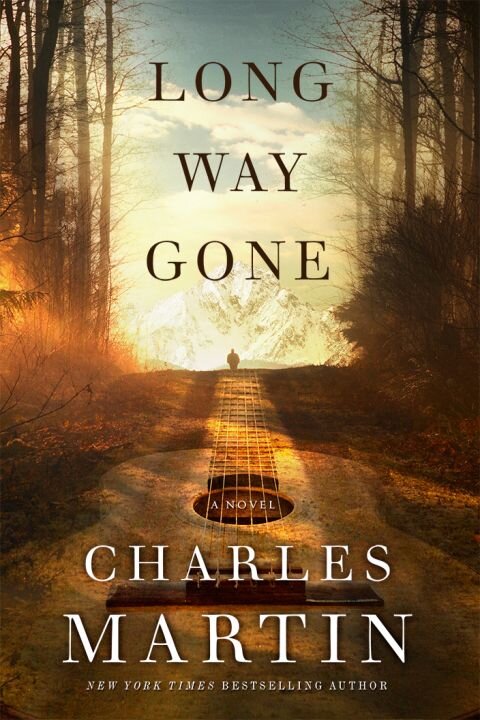
book review: long way gone

long-way-gone.jfif

Amazon says Long Way Gone by Charles Martin is a modern retelling of the parable of the prodigal son. It’s not. However, aside from that being a ridiculous description, the book was a fun read. There were too many deus ex machina moments for me to say it was a great read — specifically, three highly over-contrived moments that stood out — but I still enjoyed the story.

In summary: Cooper grows up as the musical side of his pastor-father’s tent revivals. But he longs to be a songwriter and flees to Nashville where he falls in love with a singer named Daley. A scheming manager and terrible injury destroy their relationship. Years later, Cooper returns to his hometown, and Daley passes through to sing at his club. They rekindle their relationship and help each other learn about faith and forgiveness.

I’m not super musical, but I’m music literate. So I enjoyed much of the concept of the musician being trained in dozens of styles standing out among professionals who only know their own thing. I also enjoyed hearing about beautiful Music City as well as getting a new grasp on the shorthand professionals use to annotate music. Fun glimpses.

In a sweet moment between the two main characters, the protagonist (the male) observes that his girlfriend often touches him without realizing it or looking over, almost like she’s sending out a sonar ping to see how close he is and make sure he is still within proximity. I chuckled because I think I do that to my husband, and the idea of sonar ping makes me feel like we are submarines. But I think it was mostly that most of the book analogies are auditory due to the musical story.

One thing jumped out that probably isn’t new to many people but the protag also makes the observation that what sets a great musician apart from a good musician isn’t how many notes s/he can play, but knowing which notes to leave out. That is a profound statement, as I believe the same is true for writers (or aspiring ones, like me). It isn’t the length of the sentence or the paragraph or the novel, it’s choosing the right words and not adding anything unnecessary.

I also don’t personally enjoy angels appearing and talking to people in books — I find that distracting — and that happens on several occasions.

Reasons this is not at all the parable of the prodigal son:

  • There is no older son - a HUGE element to the lesson of this parable

  • The father dies before the son returns so WHAT and HOW. Just no. I mean that is literally the point.

  • The son hits rock bottom but then becomes wildly successful in his chosen field.


Click Here to View the Full Blog Archive.      


BOOK REVIEW: Struck Down But Not Destroyed

struck-down-h.jpg

Anxiety is complex to understand, both for the person experiencing it and for their loved ones. I don’t personally struggle with anxiety, but several key and beloved people in my life live this struggle daily. At the recommendation of a friend, I decided to tackle Pierce Taylor Hibbs’ book for the sake of learning more about their journey.

I’ll be honest — the anxiety of the people I love is often confusing to me. I love them, and I want to understand — but I can’t. This book, Struck Down But Not Destroyed, is written for people of faith suffering with anxiety or those living with someone who deals with this mental health challenge. It is written from a Christian perspective and begins by addressing some common misconceptions. He directly addresses nonsense those with anxiety might hear such as this is a punishment for sin, that if you lived with more faith the anxiety would disappear, or that using medication means you are not fully relying on God. This seems elementary, but the misinformation spread by (sometimes) well-meaning people can have devastating effects. I think of some of the lies that have been spoken to me in my areas of weakness, and I shudder to imagine the devastation that someone already struggling with anxiety would feel to be told it’s their own fault.

For the rest of the book, the author spells out many of the coping mechanisms that have been instrumental in helping him deal with his anxiety disorder. He tells many personal stories and explains in detail his experiences and the way he felt physically, spiritually, mentally, and emotionally. He talks about being acutely aware of his breathing, of adrenaline rushes, and feeling like his throat was closing. These visceral details offered me great insight into the experience of an anxiety 'attack,' as well as the everyday challenges that others around him don't even notice typically. Others might only recall “Piece has anxiety” when he’s having an “attack,” but it’s something he’s aware of nearly all the time.

The author emphasizes the power of prayer and the support of his wife and family. His thesis is, "We are crushed to be called." He would seem to state that in any difficulty or challenge, God can bring us closer to Him. The author postulates that anxiety is no different and uses scripture, his own experience, and practical theology to construct a six-point plan for handling anxiety as a tool to draw closer to the Lord. He shares the acronym CHRIST to be helpful: consider the feelings as spiritual medicine, He knows, remember the promise, identify a focus, stay engaged, and talk.

I cannot recommend this to anyone who personally lives with anxiety, because that is not my life experience. I feel like that would be akin to recommending the best caramel candy when I don’t eat caramel. So I’ll simply say that I found this book helpful in better understanding the complex journey of someone who lives with this challenge.

 
struck-down-v.jpg
 

Click Here to View the Full Blog Archive.      


book review: The Invention of Wings by Sue Monk Kidd

81hTbnROjvL.jpg

Obviously, I’m the only person who hasn’t read The Secret Life of Bees, but I did read The Invention of Wings. I was very intrigued by the story of the Grimke sisters, who seem to be feminists and abolitionists born before their time. Born forty years later, and they’d be celebrated like Elizabeth Cady Stanton and many other prominent historical figures who they greatly influenced. (This story is a fictional, but plausible story of the older sister Sarah’s life.)

Handful is a slave ‘given’ to Sarah as a birthday present, and their relationship changes the course of Sarah’s life. Years later, under Sarah’s influence, her sister would pen the groundbreaking pamphlet An Appeal to the Christian Women of the South. At least according to the novelization, the women were on the course to greater influence when they began attracting too much attention in the form of men (instead of just women) attending their rallies. The offense of being feminists in addition to abolitionists caused even their beloved Quaker church to abandon them.

The story includes a fair amount of deep sadness due to the content being heavy with a failed slave revolt, great abuses of slaves, and more. Handful and her mother Charlotte put a face on the first cause Sarah is fighting for—the abolition of slaves. Her powerlessness to free her friends or even help them is part of what makes the connection between abolitionism and feminism so personal for Sarah.

The author does a good job, in my opinion, of contextualizing all of Sarah’s difficulties for the modern reader. At one point, Handful remarks sarcastically to Sarah’s complaining about her lack of rights as a woman to purchase a slave (to then free that person) that she (Handful) is still the one emptying a chamberpot. A good reminder to the modern reader who might be beginning to sympathize too strongly with Sarah’s situation that there’s no reasonable comparison between being denied the right to own property or attend school (as Sarah was) and the right to live free or with any hope (as slaves like Handful were).

A worthwhile read, if only to serve as a reminder the historical importance of influential Christian faith in fighting cultural evils.


Click Here to View the Full Blog Archive.      


book review: The Chilbury Ladies Choir by Jennifer Ryan

30269104.jpg

Q: With the war on, _______ will be closed down because there are no men to keep it going.

a) Major league baseball

b) Factories

c) Church choir

While a) above is actually an excellent movie (A League of Their Own), The Chilbury Ladies Choir is actually about c). The town vicar says their small town choir cannot continue with only the sopranos and altos, but the ladies decide they need music to persevere in the sadness of war. Plus, they argue, who will sing at all the funerals?

This book has five main characters, women of various professions and social status, all connected by the choir. While there was an element of predictability that removed the intrigue I was hoping for, I still enjoyed this story. Some of the story line was far-fetched, almost to the outlandish, but I sense that the author was trying to add a little bit of whimsy and happiness to the starkness of war. The lead characters were all women, of course, and each was dealing with a different aspect of being on the homefront during a difficult time. Worth reading, even if it isn’t a favorite.


Click Here to View the Full Blog Archive.      


book review: The Second Mrs. Hockaday by Susan Rivers

51dMDf4zC4L._SX331_BO1,204,203,200_.jpg

The front of this book promised ‘taut, almost unbearable suspense.’ I have to say, I was skeptical, particularly once I began reading and the style was epistolary. How unbearably suspenseful can a series of letters really be?

Turns out, pretty taut.

Talk about a page turner! This (*very) young bride’s husband is shipped off to fight the Civil War after a single day of married life together. He is a widower with a young son—hence the book title, the second Mrs. Hockaday.

The book notes tell that the story was inspired by a real incident. I’m sure there was a LOT of conjecture on the part of the author, but it sure made for a good story! Many of the letters are written by Placidia (the second Mrs. Hockaday) from jail, as she’s awaiting trial. As the reader, you have to first unravel why she’s in jail and what she’s accused of, then determine why she won’t defend herself. The nice part is, it’s mostly Southern women in the 1860s writing, so the vagueness of the details that keeps the reader in suspense feels believable as ‘ladies won’t talk about such things’ rather than anything overly contrived on the part of the author to maintain the suspense for her readers.

The conclusion was satisfying, although as in the case of most reasonably authentic war stories (and in the case of a marital conflict as turns out to be the case here) — there’s not a ‘happy’ ending so much as the avoidance of any further disaster.

Highly recommend. This was a fun read!


Click Here to View the Full Blog Archive.      


book review: A Tree Grows in Brooklyn by Betty Smith

atreegrowsinbrooklyn.jpg

How did I earn an English degree without ever reading this book? It was wonderful. This was one of those books that I’d heard referenced occasionally but still managed to know nothing about. It did not disappoint, and I can see why it’s often referenced as an iconic story. Generations of love and loss, with poverty as the background of it all. The book includes so many memorable scenes, and many realistic characters. I was actually sad for the story to end, because you know there’s so much more to come for the very real-feeling people you’ve gotten to know.

The author based the setting and many of the incidents on her own life, which is saddening based on the level of poverty. One chilling thing that comes up over and over again is a ‘game’ the family plays that they are lost and can’t find anything good to eat, which is how the parents try to distract the children when there is nothing to feed their family. The children narrowly escape many horrors and painfully endure others. Despite the setting and the reality portrayed, the story is hopeful. The protagonist Francie loves to read, using books to explore other worlds and lives, which ultimately opens up a wider future for her than most.

Francie’s hardworking mother is both a hero and an anti-hero in the book, as you watch her love for a hopeless lost cause (Francie’s father) drain the family, but as the reader, I was also inspired by the way she persevered in difficulty and stayed true to her commitment. The entire family’s story was captivating, from the younger siblings to the grandmother to the singing-waiter-father, as the author gives regular glimpses back into the parents’ earlier lives. She has a strong message of paternal sacrifice as the older generation has come to America, knowing they will be destitute and scorned for their ethnicity, but hoping that it will lead to a brighter possible future for their children and grandchildren.


Click Here to View the Full Blog Archive.