book review: little fires everywhere

PHOTO_20180904_114843.jpg

This book was so emotional for me. It explores relationships between mothers and children, particularly asking the big question: What makes a mother?  Biology? More?

The writing in this book is riveting. Beautiful, particularly since one of the characters is a mixed media artist, and I feel like I always had a very clear picture of what she was creating.

Race is a huge theme in this book.  The author makes her own opinions vividly clear--there are no redeeming qualities in the older white characters who 'try' but always miss the mark when it comes to understanding. I get the feeling that the author believes she is presenting a hopeful view of the future by allowing the white youth to be more understanding, but it makes me sad to think that she looks at me as a lost cause. 

(I need to confess that I'm a white foster parent, so I know my opinions are going to be shaped by my own personal experience.  I don't know how to say too much about the book without some spoilers, so... fair warning. Limited spoilers ahead.)

There's definitely a huge push in this story to support the birth parent who "just made one bad decision." The book presents an extremely false narrative I've often heard pushed in TV and movies that sensationalize the DHS workers who are desperate to keep kids away from their birth parents. That. Doesn't. Happen. Even most parents who have physically assaulted their children are given supervised visitation. The entire system is set up to reunify families-of-origin, NOT to create new families through adoption. But I read on and allowed her to sensationalize this for the sake of the story, even though it presents a hugely false narrative of how the system functions.

The book's biggest failing is the HUGE HUGE HUGE straw man she writes as the foster/potential adoptive mom in this book. Almost pathetic. The author sets herself up with the most ridiculous softball. I mean, if you're going to write what is supposed to be a compelling 'which mother is better', let's not have the foster mom say things like "I guess I never noticed we had only white baby dolls" or pull out an old racist, 50's-era 'heirloom' children's book as her only reading material that featured faces that match the child's. Frown. Author, you could have at least let her try. Not all foster parents are clueless white people who would say their honest idea of cultural exposure is Chinese take-out. Absurd and you lose points for taking it way too easy on yourself. You could have actually made the battle worth watching.

The saddest scene in this book for me is the conversation between two characters immediately after one of them has elected to have an abortion. The line is, "Would you have been ready to be a good mother? The kind of mother you'd have wanted to be? The kind of mother a child deserves?" The heart-wrenching selfishness of this line chills me to my core, especially because the author clearly intends it to be empowering and cleansing. 

She continues, "You'll always be sad about this. But it doesn't mean you made the wrong choice. It's just something you have to carry." The selection of the word 'carry'... shivers

The best scene in this book is when the foster/would-be-adoptive mother was on the stand in Family Court. The author intersperses the lawyer's questions with flashing memories of caring for the child. You watch the foster mom become more and more unhinged, realizing that four nights of no sleep when baby had a fever isn't enough for the legal system to view her as the mom. With each question, she recalls something else sacrificial she has done for this child (while her birth mother was entirely absent) while she recognizes that it won't be enough to change their perspective. Her mind is filled with thoughts that seemed so clear: I'm the only mother this child has ever known... But it isn't enough, and the author makes it clear that she believes biology trumps anything else and that any mistake can be forgiven for a 'real' family member. 

Bottom Line: Riveting story and truly compelling characters, but sensationalizes the reality of the system and lobs a softball straw-man to make a statement.


Click Here to View the Full Blog Archive.      


book review: the first fifteen lives of harry august

fifteenlives.jpg

This book was suggested to me by the great underbelly of the internet, What should I read next? Not a bad recommendation following Station Eleven. Literary qualities in a science fiction novel, nice for a change.

Concept: "Kalachakra" or "ouroboran" live the same life over and over. Groundhog day for a lifetime. But apparently not all of the members of this so-called Cronus Club live the same life... someone is making history speed up. Why are mobile phones in everyone's hands in 1973? Who is changing history and how? And why?

[ominous dun dun dun....]

I give this book four stars. It so easily could have been five, but I can't in good conscience say I entirely loved a book in which I had to skim several large portions to stay awake. Frankly, a few of the lives of Harry August are quite boring, like when he decides to be a philosophy professor... sorry, author, I'm not gonna read that entire lecture. Snooze.  

However, despite a couple unfortunate boring sections, the story here is awesome. Harry is always born in 1919 and lives through the same historical events each life (until things start to move too fast). Once Harry realizes that he can remember everything from the last time through (and, bonus, he is a mnemonic, a rare even among ouroborans whose recall is 100% perfect), he can learn to read and write every language on the planet. He can win bets on horse races. He can regularly save the lives of a few so-called "linears" that he knows in advance will be abused or murdered. He can become a surgeon, a soldier in WW2, a spy, a physicist, a philosopher... Under the guidance of the Cronus Clubs in every major city worldwide, Harry learns everything there is to learn (except golf, because "I like to tell myself I could have been a good golfer, if only I'd given a damn, but perhaps the simple truth is that there are some skills which experience cannot buy.") but faces an enemy who has discovered how to permanently kill the kalachakra--friends he's known for hundreds and years and dozens of lives who are not reborn.

Harry's personal conflicts are many. His relationship with his father always changes. Many opportunities to "make it right" (and no great success) shed light onto the truth that relationships will always require effort from both sides. His various marriages and friendships all show different aspects of his characters as he ages and matures (when 900 years you reach...). Interesting to hear from a character who has to decide if a dangerous spy mission is worth it because facing death means having to face potty training again.

Bottom line: lots and lots of intrigue. Super fun alternative history. Some very fascinating twists and a GREAT "I open at the close" ending.

NOTE: Philosophically, this book is extremely atheist, and I am a Christian. But for the purpose of reading fiction, I am fine with accepting the worldview of the author to enjoy an interesting and unique story.


Click Here to View the Full Blog Archive.      


Read "station eleven" right now

20170404.jpg

Got a book recommendation from a friend phrased something like this: "Kelley, we read a book in my book club recently that everyone hated and I thought you would love it." Obviously, I went to the library ASAP to get the book.

Station Eleven by Emily St. John Mandel was.... riveting. I will state up front that post-apocalyptic dystopian science fiction featuring a powerful, non-sexualized female protagonist MAY be a bit of a niche. But oh I am that niche!  People sometimes read these books about an ugly future and get depressed, but I see them as the opposite of depressing. Uplifting! It's the triumph of humanity in a situation where everything is hopeless. To me, science fiction is often no different than any other disaster (or in this case, post-disaster) story: whether the heroes are fighting Nazis or Cylons doesn't bother me. I'm here for the story.

And the story here is SOOOOO good. One of the curses of wishing to be an author, I've learned, is the constant struggle to love a book without dying of jealousy as you experience the author's talent. That was definitely a balance for me here. I just loved everything about the way Ms. Mandel wrote. She wafted between tenses, points of view, perspectives. She jumped chronologically, geographically, even philosophically. And she wove a story that I was alive inside. I am not usually big on sequels but I find myself wanting to go back to the vivid world she created because I became so engrossed in it in those 350 pages.

I loved one of the main characters, Kirsten.  I may have pictured myself as Katniss when I read THG, but I kind of had to fade out and just be a reader again when Katniss is killing or kissing people. I felt like I could hang in there with Kirsten, living the story vicariously in her character, even when she has to make really hard decisions.

(Also, she isn't always fresh & clean in the post-disaster apocalypse, and she's self-conscious because she's missing two teeth. This is critically believable to me.) It will never NOT disappoint me to read a story with a strong female protagonist who also happens to be the most effortlessly beautiful woman any person has ever seen. Boooooo on those writers.


Instead of a movie feel where you focus on primarily one character, Station Eleven definitely has a TV mini-series feel where the reader meets different people, unsure of how they will intersect. Once they serve their collective purpose, the individual characters continue on their own journeys, and you check in with many of them to see where they landed. 

My husband teases me that instead of reading an hour a night 'like a normal person,' I don't read for 10 days and then spent the eleventh day unmoving on the couch with my nose in a novel, cover to cover. And he's right--when I get into a book, I'm usually going to power straight through. And then I'm sad if it was a great story. 

I was very sad when Station Eleven ended. I would go back there.


Click Here to View the Full Blog Archive.      


Book Review: Folly

PHOTO_20180416_155439.jpg

I've read Laurie King before, but in a very different setting: Sherlock Holmes, to be precise. I wouldn't normally pick up a book that promises to "keep you up at night" because--hey--I have kids and my own nightmares to do that. However, the recommendation was really compelling, so I decided to give it a try.

Glad I did!

This book really kept my attention, but not in a terrified way. It was unsettling more than creepy, and I definitely wouldn't classify it as horror. Also, hard to call it a "thriller" when 90% of the book describes the protagonist rebuilding an old house on a beautifully forested, albeit deserted, island in the northern Pacific. 

Rae (a retired woodworking artist) has the saddest life story ever, but the book doesn't make you dwell on the darkness of her past. The experiences are presented in flashbacks to help you understand who Rae is (childhood neglect, debilitating mental health issues, sudden great loss, assault), but you aren't as the reader forced to experience these traumatic events which is something I personally don't handle well. 

The narrative is broken by journal entries from Rae, occasional correspondence, and a journal from her great-uncle Desmond, the previous owner of the house she is rebuilding. Everything weaves a very interesting tale of generational issues and PTSD (his from WW2 and hers from abuse and assault).

The tricky thing is a few random, sinister and threatening messages from an author the reader can't identify. Rae is quick to believe that anything strange she experiences is due to forgetfulness or hallucinations, but there's obviously more going on than she wants to think possible.

As the reader, you are usually left to assume that what Rae tells you is true, but Laurie King also intersperses what Rae calls "her own Watcher" where she sometimes has a sense that her mental illness is affecting her perception of a situation. It's explained that in the middle of a panic attack, Rae becomes aware that she's experiencing a panic attack and that can help her reason a bit. Rae describes it as the difference between her 'fear'--because she has had very real reasons to be afraid--and her 'anxiety,' when every twig snap sounds like a man behind her, poised to attack.

I enjoyed all three elements of the story: watching the house (named 'Folly') be rebuilt, interpreting the actions of Rae's stalker, and feeling Rae find peace and begin to heal.


Click Here to View the Full Blog Archive.      


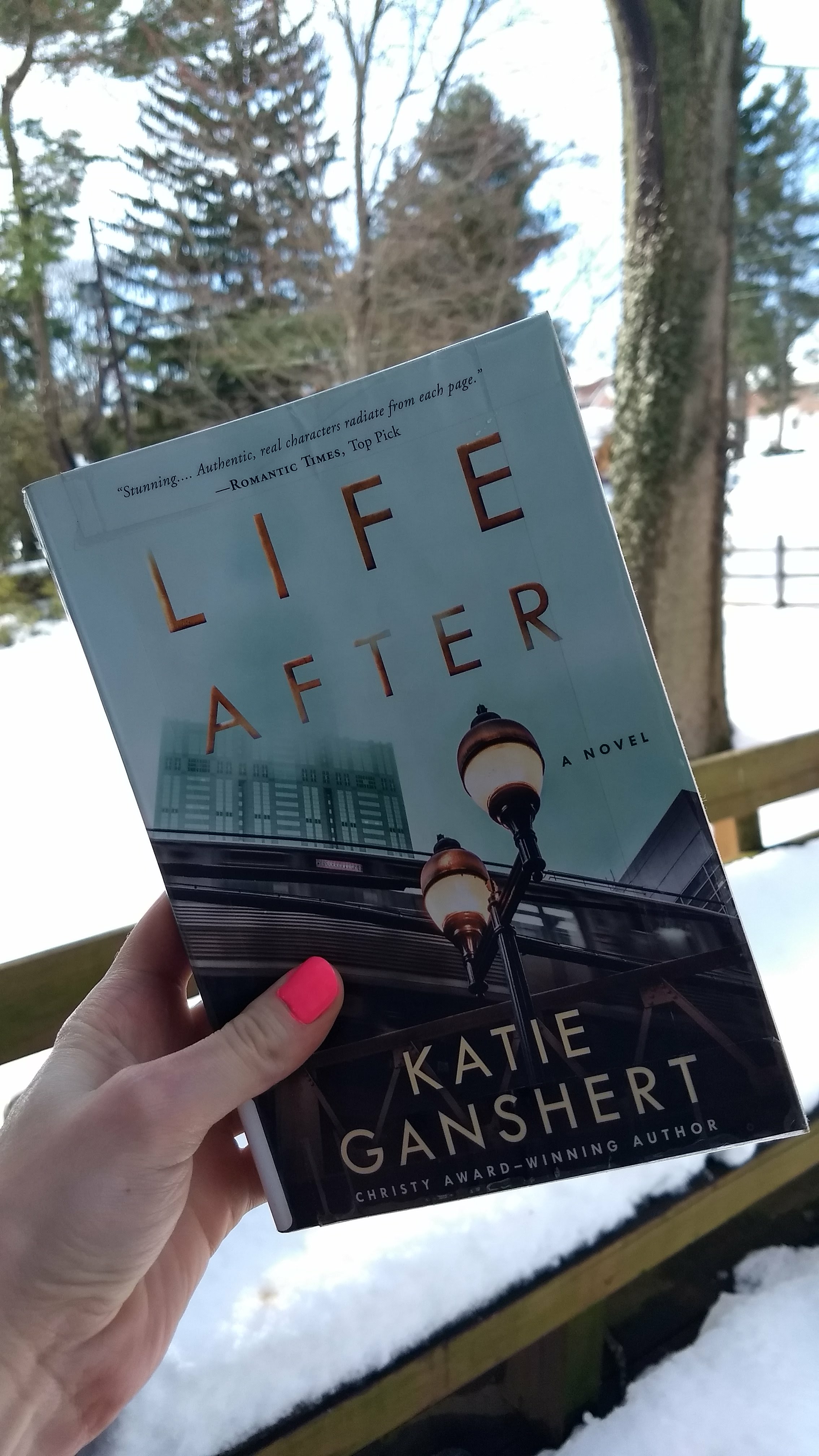
Life After: A Book Review

PHOTO_20180322_152404.jpg

Katie Ganshert's Life After is just part of a title. The rest of the title is "...I woke up as the sole survivor of a terrorist train bomb." 

(And look at this pretty picture I took of the appropriately worn library copy against the first-day-of-spring blizzard the northeast was awarded this week?)

There's a lot of heart in this story. Survivor Autumn gets to know the families of the victims  (everyone else on the train) as a way to pay tribute to their memories. She is deeply entrenched in survivor's guilt, and even has some heaped on her by a few families. Others are resilient and see her as a beacon of hope. The entire city of Chicago focuses on her with either hope/faith or anger that she can't or won't be who they expect her to be. One deceased woman's daughter connects with Autumn and, of course, then there's her handsome widowed dad... The story revolves around their intersecting church/work/therapy worlds and the two damaged but tentatively hopeful people forming a relationship.

Story element I could have done without: the "just friends" go to a baseball game. Surely, they won't be put on the big screen Kiss Cam, will they? 

Autumn seems to be true to what I've read about PTSD and survivor's guilt. You definitely see her struggle to even want to "move past" this experience before she can even consider trying to actually do so. She wanders in cemeteries and compulsively clips newspaper articles. She reads about the people online and starts a video tribute for them. Reality shows up when not everything is good and peachy and wonderful. They were real people, with issues.

I had hoped this book would be more about Autumn's recovery as a person and in her relationship with God--and less about her finding romance. (I found this novel researching comps for the novel I finished last year, which focuses on the God-protagonist relationship recovery after a tragedy.) But that's not the book this author chose to write, and I enjoyed it very much. He's FAR more than handsome; she's FAR more than wounded. A giant leap-and-a-half above many Christian romances I've read.

Recommend. 


Click Here to View the Full Blog Archive.      


Deep Water: A book review

51JlHB09oKL._SX326_BO1,204,203,200_.jpg

A book about a patent lawyer shouldn't be this interesting.

I stumbled onto this series while looking for books with a hearty story that don't go light on the science. Of all things, this book is written by a PhD in Art History. 

The story is about a clinical trial for a drug to "cure obesity" -- and there's extensive descriptions of labs, lab procedure, and a lab book which ultimately ends up factoring into the story very heavily. 

There's a lot of human drama, too -- somebody's dead ex-wife may or may not have been involved in the patent case -- and somebody's young child may or may not be suffering from a rare genetic condition impacted by the drug trial's failure.

Girl Power Highlights: Written by a woman, scientists are women (but not because they are Bond's Christmas Jones--kill me now--or some similar caricature). Drama between women isn't about dudes, so a nice passing of the Bechdel test.

The final scene was the best in the book. A lot of things pulling together into a scary, fiery, watery, stormy action sequence, touched by sacrificial family love.


Click Here to View the Full Blog Archive.